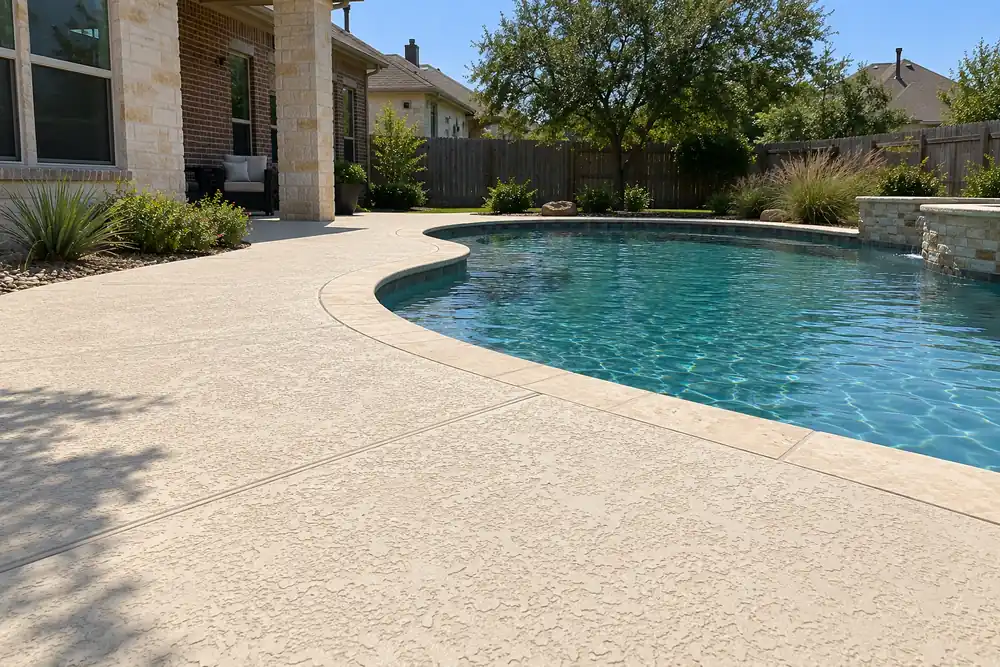
Concrete in Garland Clay Soil and North Texas Weather
Garland Elite Concrete wrote this guide because concrete in Garland, Texas, sits on clay soil: the most common soil mapped inside the city in the USDA's Dallas County soil survey is Houston Black clay, which the USDA describes as having high shrink-swell potential.
The Soil Science Society of America says construction on Houston Black is often plagued by cracking from its shrinking and swelling. Add North Texas heat, winter freezes, wet springs and dry summers, and it pays to know what the ground and the weather do to a slab before you pour one, and what fixes one that has already moved, from crack repair to leveling.
Call or request a free estimate any time, 24/7
Houston Black clay, Garland's most common soil
Texas Parks and Wildlife says the Blackland Prairies region takes its name from its deep, fertile black soils, typically dark alkaline clays often called "black gumbo." In the USDA's soil survey for Dallas County, the most common soil mapped inside Garland's city limits is Houston Black clay. Almost all of the other soils mapped in the city, among them Ferris, Heiden, Austin, Lewisville and Wilson, are clays or silty clays too.
How much clay it holds
The USDA's official description calls Houston Black a very deep soil formed from calcareous mudstone, with 40 to 60 percent clay. The Soil Science Society of America gives 46 to 60% clay and says Houston Black covers about 1.5 million acres in 33 Texas counties, across a Blackland Prairie that runs from north of Dallas to just south of San Antonio.
How it moves
The USDA rates Houston Black's shrink-swell potential as high. In dry periods it cracks ½ to 4 inches wide at a depth of 12 inches, and the cracks stay open for 90 to 150 days in most years. Water enters rapidly while the soil is dry and cracked, and very slowly once it's moist. The USDA's soil database measures shrinkage as "linear extensibility" and lists 17 percent for Houston Black in the map unit most common in Garland.
Call or request a free estimate any time, 24/7.
(945) 441-5958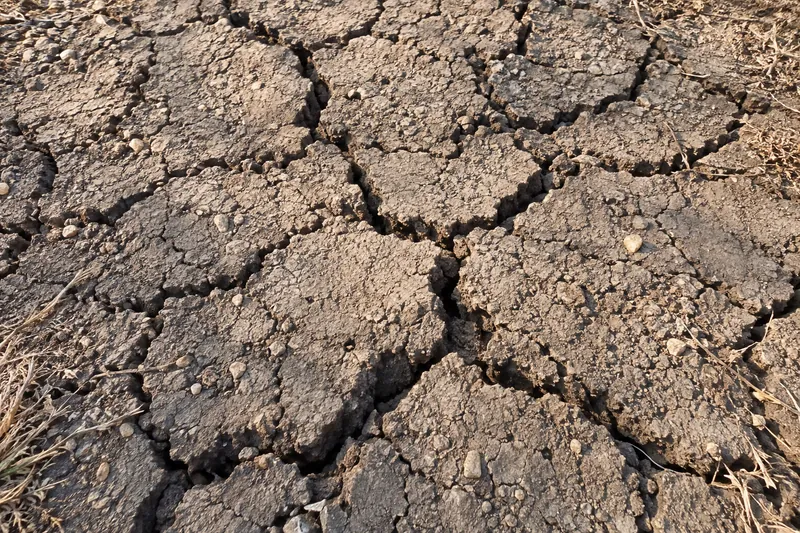
What the soil survey says about driveways and slabs
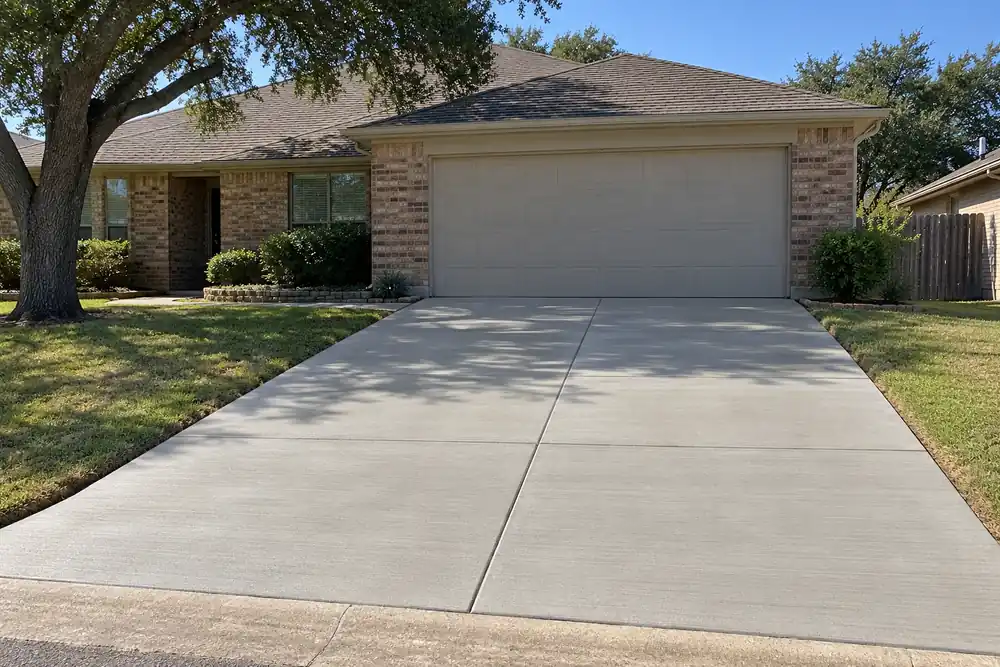
The USDA soil survey rates each soil for concrete driveways and sidewalks, which it defines as reinforced slabs 3 to 6 inches thick. Houston Black, as mapped in Garland, is rated "Very limited," with high shrink-swell as the reason, and so are Branyon, Ferris and Heiden. In the survey's wording, "Very limited" means the soil's limitations generally can't be overcome without major reclamation, special design or expensive installation, and that poor performance and high maintenance can be expected. The same four soils are rated "Very limited" for dwellings on a concrete slab.
Want a slab planned for your soil? Call or request a free estimate, 24/7.
(945) 441-5958Building concrete for expansive clay
Clay changes how concrete is built. What follows is industry and City practice, not a promise about any one job.
Base, reinforcement and joints
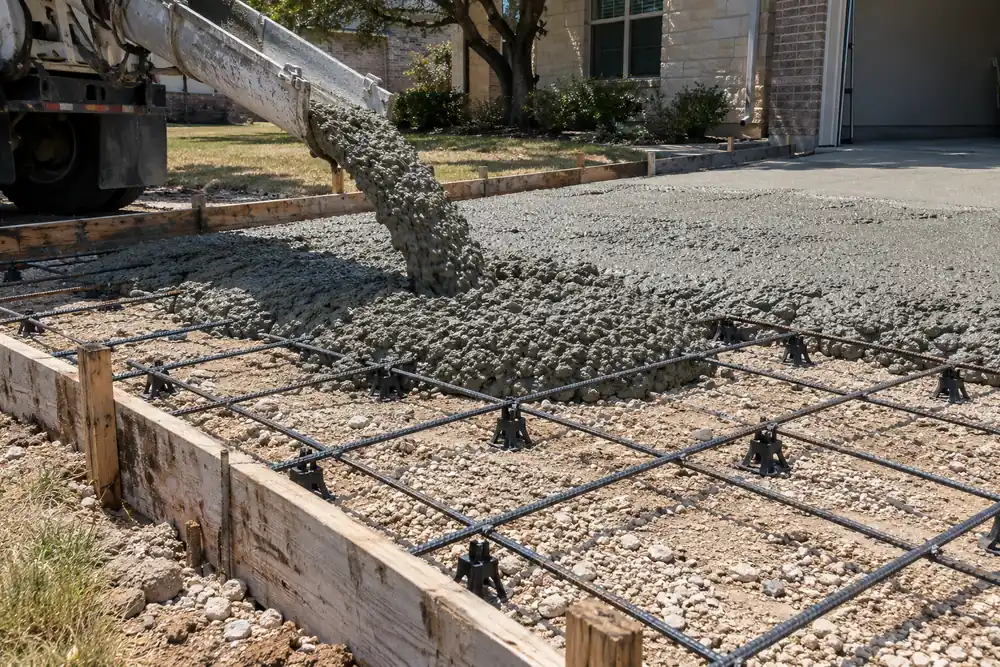
Against clay that swells when wet and shrinks when dry, the usual defenses are good compaction and drainage, or a structural or post-tensioned slab that doesn't rely on the soil for support. On expansive soils, 2 to 8 inches of crushed rock is the recommended subgrade material, depending on how expansive the soil is. Steel helps but doesn't stop cracks: the National Ready Mixed Concrete Association says reinforcement can limit crack width, not prevent cracking, and needs at least 2 inches of concrete cover. NRMCA calls joints planned cracks and spaces them no more than 24 to 36 times the slab's thickness, about 10 feet for a 4-inch slab. For driveways, Garland's own minimum is 4 inches of concrete with Number 3 rebar 18 inches on center.
- Control joints no more than about 10 ft apart on a 4 in. slab (NRMCA)
- Broom texture on exterior slabs (NRMCA)
- Concrete slab; Garland driveways are 4 in. minimum (City of Garland)
- Steel at or just above mid-depth, with 2 in. of cover
- Crushed rock, 2 to 8 in. on expansive soil
- Houston Black clay subgrade (USDA)
How the City builds streets on this soil
For its own streets and alleys, Garland's Technical Standards Manual requires lab tests of how much the soil swells. If swell potential is over 2%, a geotechnical engineer must recommend how to bring it to 2% or less, and moisture treatment must limit Potential Vertical Rise, an estimate of soil heave, to 4.5 inches. Every standard street section sits on at least 8 inches of stabilized subgrade, at the City's standard rate of 18 pounds of lime and 36 pounds of cement per square yard.
Slabs and foundations
For a new concrete slab or foundation, the Post-Tensioning Institute describes post-tensioned slabs-on-ground as a cost-efficient, high-performance answer to foundation problems on shrink-swell soils: the compression put into the slab resists the tension that soil movement creates. The Soil Science Society of America says hydrated lime is often added to stabilize Houston Black clay, and that building foundations on it need steel reinforcement.
Drainage and grading
Wet clay swells, so grading matters. The 2015 International Residential Code, which Garland has adopted, requires the ground to fall at least 6 inches within the first 10 feet from a house, and paved surfaces within 10 feet of the foundation to slope at least 2 percent away from the building.
Call or request a free estimate any time, 24/7.
(945) 441-5958North Texas weather and fresh concrete
The figures below are the National Weather Service's and NOAA's for the DFW Airport station unless another station is named.
Summer heat
NOAA's 1991–2020 normals put the average July high at 95.6°F and August's at 95.8°F. The Weather Service counts an average of 20 days a year reaching 100°F, the first on July 1 and the last on August 27 on average, with a record 71 in 2011. The National Ready Mixed Concrete Association says high concrete temperature raises water demand, which lowers strength and durability, and speeds up setting, so finishing has to move faster; a slab poured on a hot day followed by a cool night can crack from the quick change. It advises avoiding the hottest part of the day and curing for at least 3 days, and lists wind over 5 mph, low humidity and high temperatures as the conditions behind plastic shrinkage cracks. The American Concrete Institute's hot-weather specification limits concrete to 95°F at the time it's discharged from the truck.
Freezes
DFW averages 29 freeze days a winter, and NOAA's nearby Richardson station averages 34.7 days a year at 32°F or colder. Over DFW's full record, the Weather Service gives an average first freeze of November 22 and an average last freeze of March 12. NRMCA says fresh concrete freezes below about 25°F and can lose more than 50% of its potential strength, so it should be protected from freezing until it reaches 500 psi, about two days after placement; every 20°F drop in concrete temperature roughly doubles the setting time. In February 2021, DFW stayed below freezing for 139 straight hours.
Wet springs and dry summers
May is the wettest month at 4.78 inches and October the next at 4.37, while July is the driest at 2.08, in NOAA's 1991–2020 normals. The Weather Service describes a wet spring and fall with a dry summer and winter, and yearly totals that range from under 20 inches to more than 50. NOAA's "Garland 3.6 NNW" rain gauge has a normal of 41.86 inches a year. That cycle matters for clay: the area's expansive clay soils shift dramatically between the wet, stormy spring and the dry, hot summer, causing multiple cracks to form at once.
Call or request a free estimate any time, 24/7.
(945) 441-5958When a slab has moved
Movement shows up as cracks, or as a slab that has sunk, tilted or lifted. The fix depends on which, and on why.
Cracks
Not every crack is a failure. The National Ready Mixed Concrete Association says all concrete tends to crack, and that most random cracks that appear early, although unsightly, rarely affect the structural integrity or service life of concrete. Thin cracks of about ⅛ inch can usually just be repaired; cracks or holes under ¼ inch can be filled or patched as a temporary fix, though patches aren't watertight; and cracks over ¼ inch, spalling and discoloration can be covered with resurfacing or an overlay.
Sunken or tilted slabs
A sinking slab very often sits on poorly compacted fill dirt, with erosion under the slab and shrinking soils also possible. Concrete leveling, or slabjacking, lifts the slab back by pumping grout or foam underneath it. The two differ in practice: mudjacking slurry needs 1.5- to 2-inch injection holes and a 24-hour cure, while polyurethane foam needs 0.50- to 0.63-inch holes and cures in about 15 minutes. Lifting isn't always the answer: the International Association of Certified Home Inspectors says mudjacking isn't appropriate when a slab has risen from expansive soil or when the cause of the settling isn't addressed. The City uses the same idea on its streets: where settled pavement is otherwise in good condition, its contractor can inject polyurethane underneath to lift it back to its original elevation.
On public sidewalks, Garland's code counts a height difference of 2 inches or more, or a gap of 1½ inches or more, as a hazard the owner must fix.
Foundation repair permits
If the slab under the house has moved, Garland requires a foundation repair permit whenever the repairs cost $2,000 or more. The permit costs $45 ($30 plus a $15 processing fee), and the application must include an engineer's letter.
Call or request a free estimate any time, 24/7.
(945) 441-5958Soil and weather questions
Can concrete be poured in winter in North Texas?
Yes, with protection. The American Concrete Institute treats a pour as cold-weather concreting when the air falls, or is expected to fall, below 40°F during the protection period. In NOAA's 1991–2020 normals, DFW's median first freeze is November 24 and its median last freeze is March 8.
Does homeowners insurance cover a sunken slab?
Usually not for the lift itself. Insurers typically treat settling concrete as normal wear and tear or maintenance, so polyjacking isn't covered unless the settling came from a covered event such as a plumbing leak.
Planning concrete on Garland clay?
Call or send a request any time, 24/7, for a free estimate. We'll talk through the base, reinforcement and joints for your soil.