Concrete Parking Lots in Garland, TX
Garland Elite Concrete builds and replaces concrete parking lots in Garland, Texas, along with the fire lanes, curbs, islands and accessible stalls that go with them. The American Concrete Institute's parking lot guide says concrete lots typically have service lives of 20 years or more, run cooler than asphalt lots and are minimally affected by leaking petroleum products.
Call or send the form for a free estimate, whether you have an engineer's site plan or only a stall count and the kind of traffic the lot will carry. We'll talk through thickness, joint layout and drainage for your site.
Call or request a free estimate any time, 24/7
No charge · answered 24/7
Get free estimates
Parking lot layout: stalls, aisles and fire lanes
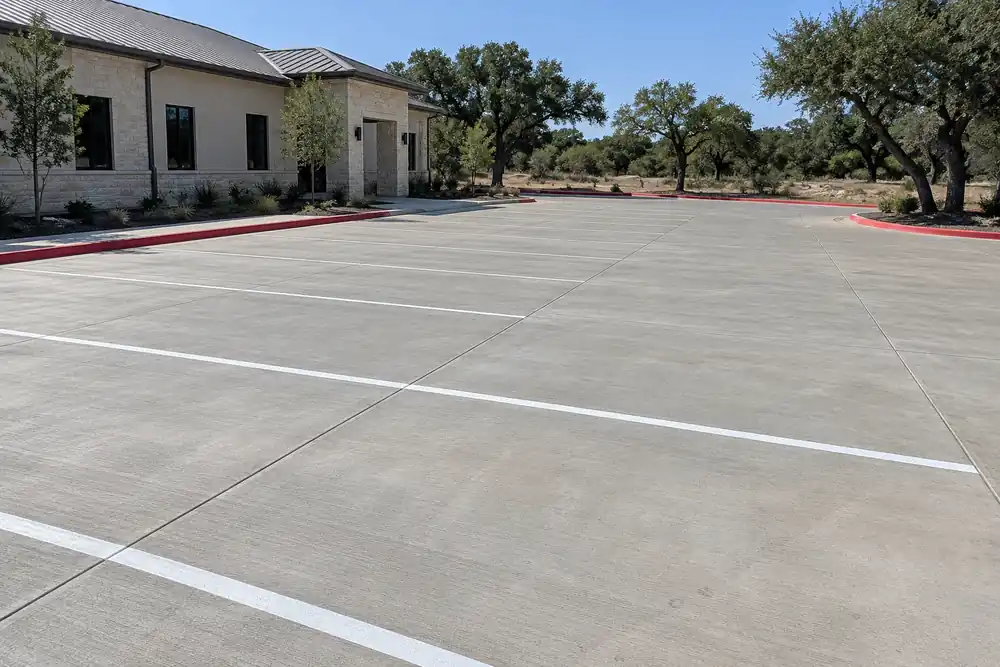
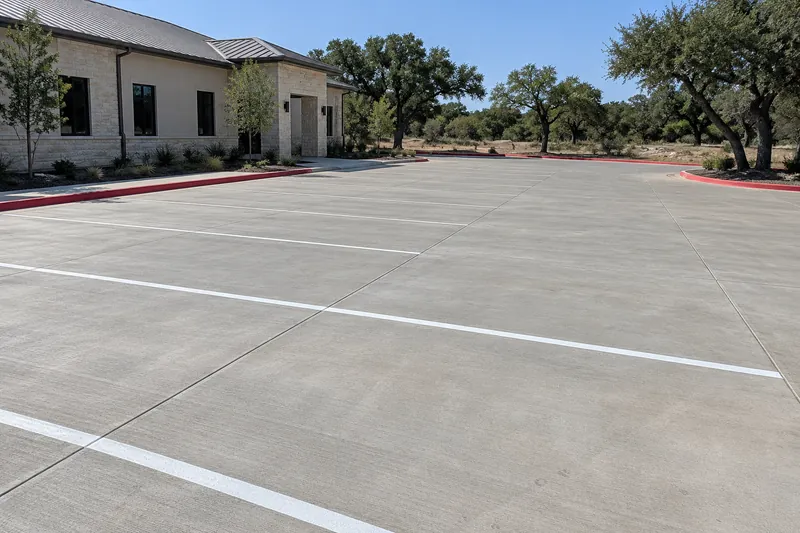
Most lots take up 300 to 350 square feet per car. Garland's Technical Standards Manual draws its typical 90-degree stall 9 feet wide and 18 feet deep, opening onto a 24-foot aisle.
Fire lanes
Fire lanes get a thicker section than the rest of the lot. The City requires at least 6 inches of reinforced Class P1 concrete (4,000 psi) over an engineered subbase, and its site-plan checklist gives a 24-foot width, with a turnaround at dead ends longer than 150 feet.
Curbs, islands and edges
Garland requires a raised curb at least 6 inches high, or a similar device that stops vehicles, between parking and islands, sidewalks and other areas cars shouldn't enter. The National Ready Mixed Concrete Association (NRMCA) recommends a thickened edge on the outside of slabs that take wheel loads, usually built as an integral curb. Curbs along drives and streets are covered on our curb and gutter page.
Parking lots are one part of our commercial concrete work, next to industrial floors and tilt-wall buildings. Outside the city, Garland Elite Concrete also builds commercial concrete parking lots in Plano.
Call or request a free estimate any time, 24/7.
(945) 441-5958Thickness, mix and reinforcement
How thick a parking lot should be
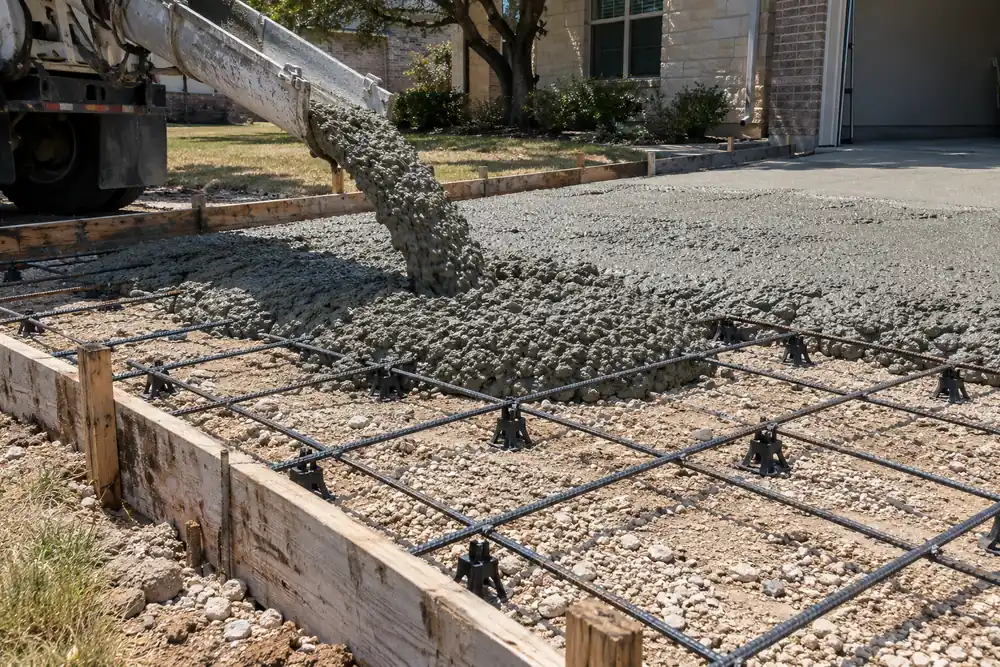
The NRMCA says 4 inches of unreinforced concrete is usually satisfactory where only cars and pickups park, while lots with light trucks may need 5 or 6 inches. In the ACI 330 thickness table the NRMCA reprints, car parking areas on weak subgrade call for 4.0 inches, and entrance lanes carrying 700 multiple-unit trucks a day call for 8.0 inches. Garland's minimum is higher than the car figure: 5 inches of reinforced concrete over an engineered subbase.
Strength and workability
At 28 days, 4,000 psi is the NRMCA's figure for most parking areas unless design or durability calls for more, and it recommends a slump of 3 to 5 inches so the pavement places and finishes well. For the surface, it pairs a bull-float finish with a light broom texture for skid resistance.
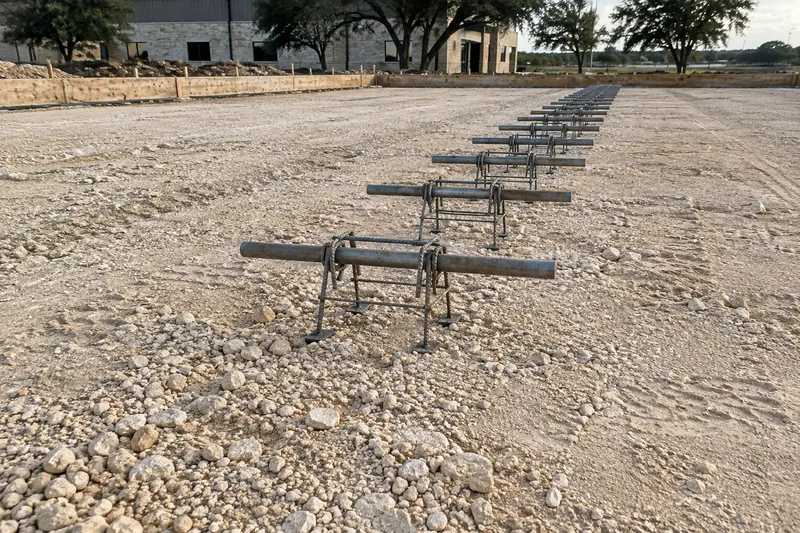
- Contraction joint cut at least ¼ of the depth, 15 ft apart at most (NRMCA)
- Light broom texture over a bull-float finish (NRMCA)
- 5 in. reinforced concrete minimum (City of Garland)
- Engineered subbase (City of Garland)
- Houston Black clay, high shrink-swell (USDA)
Call or request a free estimate any time, 24/7.
(945) 441-5958Joints, drainage and clay subgrade
Joint layout
The NRMCA keeps joint spacing within 24 to 30 times the pavement thickness, and its parking lot FAQ, citing American Concrete Institute documents, caps contraction and construction joints at 15 feet whatever the thickness. Joints are laid out in square panels where possible; a rectangular panel's long side should be no more than 1.5 times its short side. Full-depth isolation joints go only around fixed objects, and ACI 330R-08 does not recommend them as regularly spaced joints.
Slope, drainage and clay soil
The NRMCA slopes parking pavement 1%, or 1/8 inch per foot, toward drainage points. The most common soil mapped in Garland is Houston Black clay, which the USDA gives high shrink-swell potential, with dry-season cracks ½ to 4 inches wide. It also notes that water enters this soil rapidly when it is dry and cracked, and very slowly when it is moist. We'll talk through the subgrade and drainage your lot needs.
Call or request a free estimate any time, 24/7.
(945) 441-5958Parking lot repair and upkeep
ACI's parking lot guide lists the maintenance options for an aging lot: joint resealing and crack sealing, partial-depth and full-depth repair, and stabilization and slab jacking. Those jobs are covered on our commercial concrete repair page.
At the street, Garland's code makes the abutting owner responsible for keeping the sidewalk, parkway, curb and driveway in good and safe condition. Work on public property needs city permits, including a Right-of-Way Permit and a Sidewalk and Driveway Approach Permit, and the City's Parking Lot Repairs page adds that city sidewalk work needs a Sidewalk Bond on file.
Call or request a free estimate any time, 24/7.
(945) 441-5958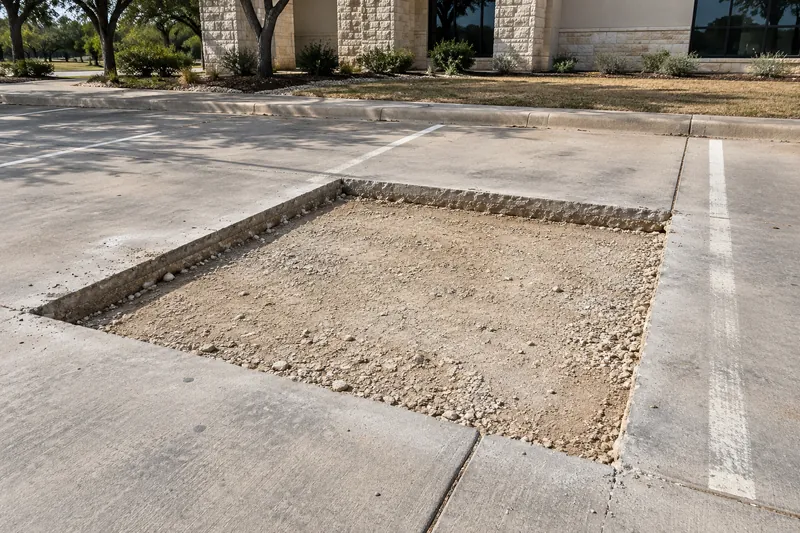
Parking lot paving cost
In 2026 national figures, the average parking lot paving job runs $75,000, and concrete $4 to $7 per square foot. Another 2026 national estimate runs higher for concrete, at $5 to $10 per square foot or $1,500 to $3,500 per stall, with striping at $4 to $5 per standard stall.
These are national averages, not prices from Garland Elite Concrete. A real number needs your plans and a look at the site, and the estimate is free.
- Concrete, per sq ft
- $4–$7
- Average paving job
- $75,000
National parking lot averages, 2026. Not a quote.
Call or request a free estimate any time, 24/7.
(945) 441-5958Parking lot questions from property owners
What are the parking lot regulations in Texas?
In Garland, the City's Technical Standards Manual sets the paving and layout: at least 5 inches of reinforced concrete over an engineered subbase, fire lanes of at least 6 inches of reinforced 4,000 psi concrete, a raised curb of at least 6 inches around islands and walks, and no tandem parking for multifamily, retail and similar developments. The 2010 ADA Standards set the number and size of accessible spaces. Rules change, so confirm current requirements with the City before you build.
How many accessible parking spaces does a lot need?
Under the 2010 ADA Standards, a lot of 1 to 25 spaces needs 1 accessible space, 26 to 50 needs 2, 51 to 75 needs 3, and 76 to 100 needs 4, and at least one in six accessible spaces must be van-accessible. Car spaces are at least 96 inches wide and van spaces 132 inches, with 60-inch access aisles at the same level as the spaces, sloped no steeper than 1:48. Nationally, striping an accessible stall typically runs $25 to $40.
Does a parking lot need rebar or wire mesh?
By the NRMCA's guide, 4 inches of unreinforced concrete is usually satisfactory for cars and pickups. Its parking lot FAQ adds that welded wire mesh gives no increase in structural capacity; the mesh only keeps cracks tight, and only when it's placed correctly. Quoting ACI 330R-08, the FAQ also says round dowels can be impractical in pavements 7 inches thick or less. Garland, though, requires parking lot paving to be reinforced concrete.
Does a parking lot need a subbase?
The NRMCA says no special subbase is required under a concrete lot, as long as the subgrade's soil type, moisture content and density are uniform. Its FAQ quotes ACI 330R-08 that pavements carrying fewer than 200 heavily loaded trucks a day normally won't be damaged by pumping, so they don't require subbases. Garland sets its own rule: parking lots and fire lanes both go over an engineered subbase.
How long does it take to build a parking lot?
A parking lot typically takes 2 to 4 weeks to install. Within that, the NRMCA says curing should start right after finishing and typically continue 3 to 7 days, and it calls liquid membrane-forming curing compound usually the most cost-effective way to cure a lot.
Free parking lot estimates in Garland
Garland Elite Concrete answers calls and estimate requests 24/7 for new parking lots, fire lanes, curbs and lot repairs in Garland and nearby cities. Send a site plan or tell us the stall count and what the lot carries.