Concrete Slabs and Foundations in Garland, TX
Garland Elite Concrete pours concrete slabs and foundations in Garland, Texas, from house and garage foundations to shop floors, pads and post-tensioned slabs. The most common soil mapped in the city is Houston Black clay, and the USDA soil survey rates it "Very limited" for dwellings on concrete slab because of its high shrink-swell.
Call or send the form for a free estimate. We'll talk through the slab's size and thickness, the reinforcement and base your soil calls for, and whether the design needs an engineer.
Call or request a free estimate any time, 24/7
No charge · answered 24/7
Get free estimates
Slab-on-ground foundations and floor slabs
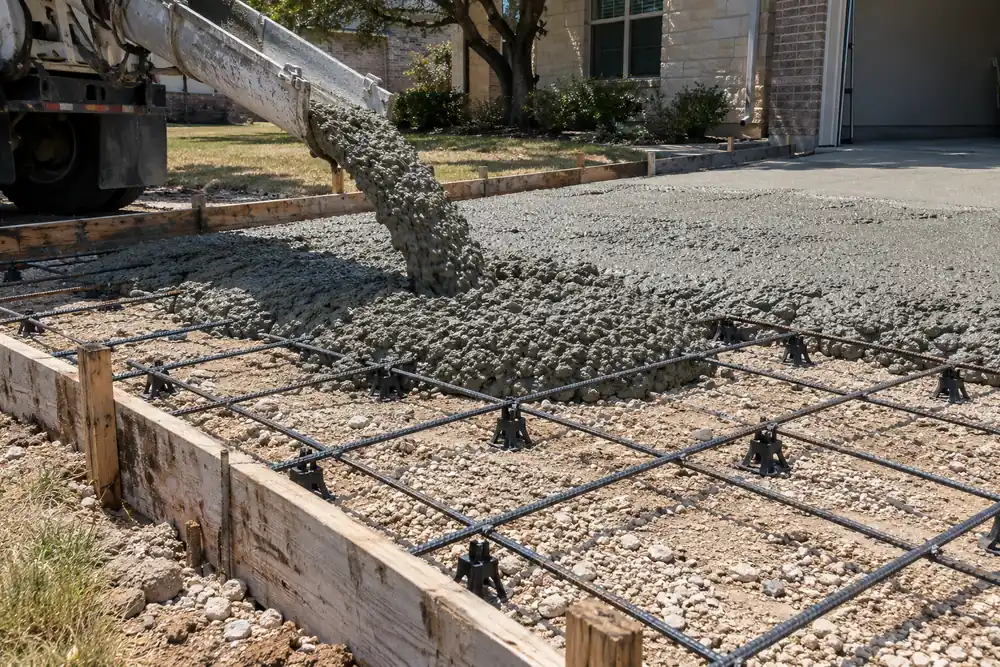
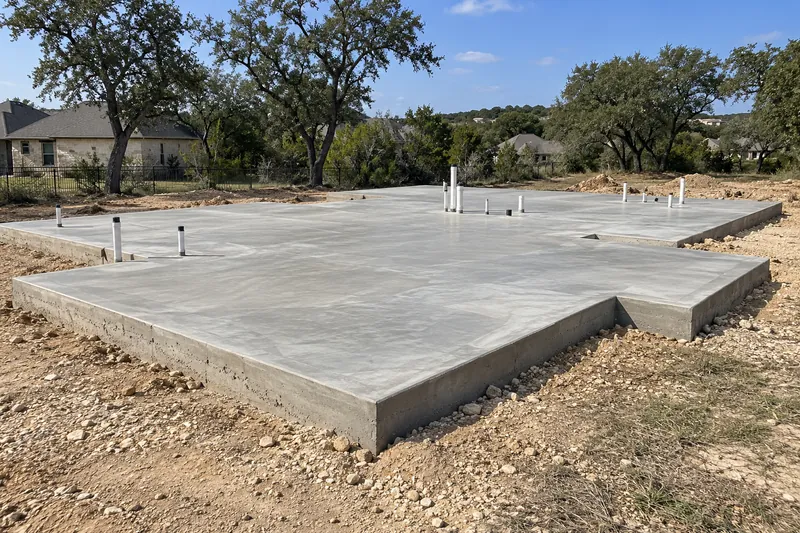
Garland builds to the 2015 International Residential Code (IRC), which sets a minimum of 3½ inches for a concrete floor on the ground, over a 4-inch base course of clean graded sand, gravel or crushed stone where the slab is below grade. A home foundation is typically 6 inches thick and carries steel rebar, vapor barriers and foam insulation.
Reinforcement
Concrete's tensile strength is only about 15% of its compressive strength, which is why slabs crack when they bend, and rebar or mesh has to sit at or just above mid-depth to work. A common rule of thumb is rebar or welded wire fabric in any slab more than 5 inches deep, especially under heavy loads. For Houston Black clay, the Soil Science Society of America says building foundations need to be reinforced with steel.
Vapor retarders
The National Ready Mixed Concrete Association (NRMCA) recommends a vapor retarder at least 10 mils thick under interior slabs and calls it sensible planning to put one under every interior floor slab, while exterior slabs on grade generally don't need one. The IRC exempts garages and other unheated accessory buildings from its vapor retarder rule.
Garage floors, pads and shop slabs
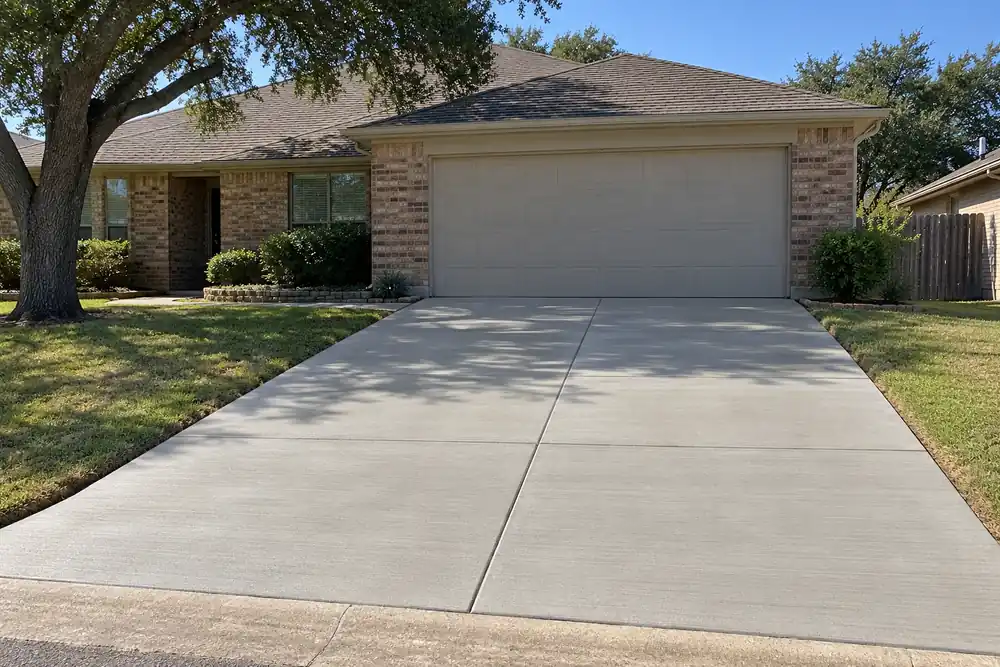
Smaller slabs carry their own rules. The IRC requires a garage's parking area to slope toward a drain or the main vehicle door, and a slab for a large RV of 12,000 pounds or more may need to be 5 or 6 inches thick. Both are covered on our concrete garage floors and concrete pads pages.
Call or request a free estimate any time, 24/7.
(945) 441-5958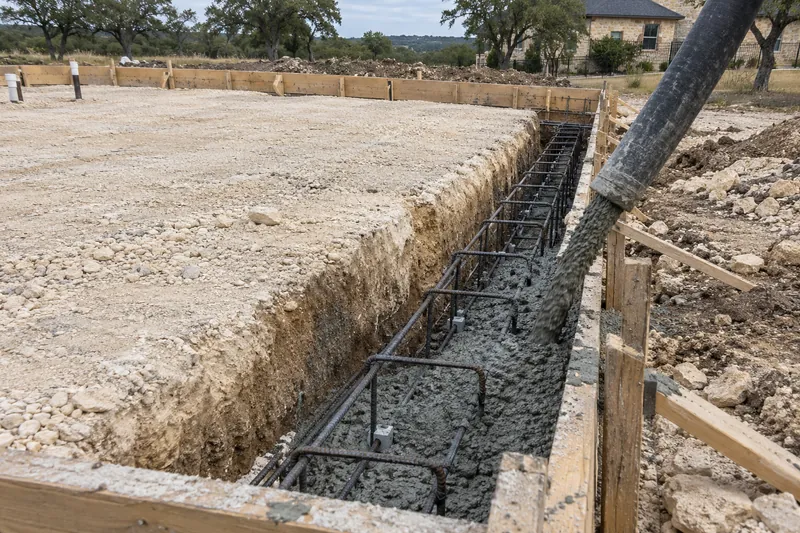
Post-tension slabs for shrink-swell soil
The Post-Tensioning Institute (PTI) describes post-tensioned slabs-on-ground as a cost-efficient, high-performance answer to foundation problems on shrink-swell soils. Steel tendons are stressed after the pour, and the compression they put into the slab resists the tension that soil movement causes.
How the tendons are stressed
A residential post-tensioned slab is typically 8 inches thick with 3,000 psi concrete, and tendons at 48 inches on center are common. The tendons are stressed once the concrete reaches 2,000 psi, typically within the 3 to 10 days PTI recommends. Each cable is pulled to 33,000 pounds, which stretches a 100-foot cable about 8 inches.
Design rules and cautions
PTI's design guidelines for post-tensioned foundations on expansive soils date from 1980 and have been used on millions of residential foundations. The International Building Code (2015, as PTI quotes it) requires post-tensioned slabs on expansive soils to be designed to PTI's standard DC 10.5. Once the slab is poured, it should never be cut or drilled, because a cut tendon is very difficult to repair.
Outside the city, Garland Elite Concrete also pours concrete slab foundations in Fate.
Call or request a free estimate any time, 24/7.
(945) 441-5958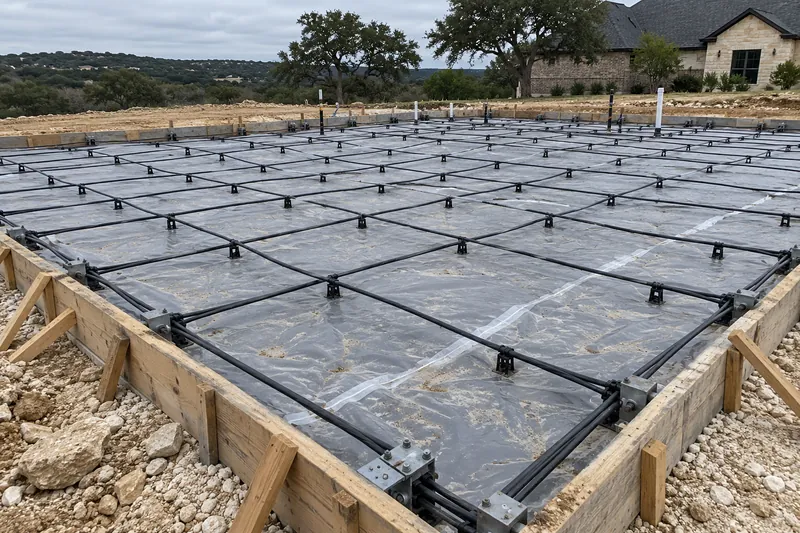
Building on Garland's clay soil
The USDA describes Houston Black clay as having high shrink-swell potential: in dry periods it cracks ½ to 4 inches wide, down to 12 inches or more, and the cracks stay open 90 to 150 days in most years. In the USDA's wording, its "Very limited" rating for dwellings on concrete slab means limitations that generally can't be overcome without major soil reclamation, special design or expensive installation.
Base, drainage and lime
The usual defenses against expansive clay are good compaction and drainage that keeps the soil from getting wet, or a structural or post-tensioned slab that doesn't rely on the soil for support. The Soil Science Society of America notes that hydrated lime is often added to stabilize these clays, and the 2015 IRC requires the ground to fall at least 6 inches within the first 10 feet from a house.
Soil tests
Expansive clay can call for soil stabilization, deeper footings or reinforced concrete, and a soil test typically costs $500 to $2,000. Our guide to concrete in Garland clay soil covers the soil survey in more detail.
Beyond Garland, Garland Elite Concrete pours concrete slabs and foundations in Lavon as well.
- 3½ in. minimum floor on ground (IRC 2015); house foundations typically 6 in.
- Rebar or mesh at or just above mid-depth
- 4 in. base course where the slab is below grade (IRC 2015)
- Houston Black clay, "Very limited" for dwellings on slab (USDA)
Call or request a free estimate any time, 24/7.
(945) 441-5958Slab and foundation cost in the Dallas area
In 2026 Dallas-area figures, a new slab runs $4 to $8 per square foot, with most projects between $3,712 and $7,423 ($5,567 typical), about 3% above the national average. The average Dallas-area foundation comes to about $7,427, within a range of $3,134 to $11,714. Soil conditions, site access and foundation type are the main price factors, and foundations on Blackland Prairie clay need structural reinforcement, which raises the price.
Access can mean a pump. The American Concrete Institute notes that pumping is useful where space for equipment is limited. Line pumps generally suit driveways, slabs and short distances, and boom pumps suit large foundations; see concrete pumping.
These are published averages, not prices from Garland Elite Concrete. Your estimate is free and based on your site.
- Standard slab
- $6
- Rebar reinforced
- $7
- High-strength
- $8
- Fiber mesh
- $10
- Foundation, 8–10 in. thick
- $12–$18
Typical Dallas-area prices, 2026. Averages, not a quote.
Call or request a free estimate any time, 24/7.
(945) 441-5958Post-tension and foundation questions
Is post tension slab better than rebar?
The Post-Tensioning Institute lists three advantages over a comparable rebar- or wire mesh-reinforced slab: less concrete and steel for the same structural capacity, tighter cracks, and often faster installation. It calls post-tensioned slabs-on-ground a cost-efficient solution on shrink-swell soils. On expansive soils, the International Building Code (2015, as PTI quotes it) requires them to be designed to PTI's DC 10.5 standard.
What are the disadvantages of post tension slabs?
Later changes are harder. Never cut or drill into a post-tensioned slab, since a cut tendon is very difficult to repair. Each strand carries 25,000 to 33,000 pounds of force, so cutting or coring needs ground-penetrating radar scanning first, and a core within 6 inches of a marked tendon needs a structural engineer's review. The slab also has to be engineered to PTI's standard on expansive soils.
How much does a concrete foundation cost in the Dallas area?
In 2026 Dallas-area figures, a slab foundation runs $6,000 to $15,000, a monolithic slab $8,000 to $18,000, a stem wall $6,000 to $18,000 and pier and beam $8,000 to $15,000. A Dallas building permit for foundation work averages $410 to $2,600, and a foundation inspection $600 ($300 to $3,000). In Garland, check permit requirements with Building Inspection (972-205-2300), and send your plans to Garland Elite Concrete for a free estimate.
What psi concrete is used for a slab foundation?
Around Dallas, 3,000 psi is the standard, and the common advice is to go up to 3,500 psi for patios and 4,000 psi for driveways, garage floors and foundations because of the shifting clay soil. Residential post-tensioned slabs typically use 3,000 psi concrete. We'll talk through the mix your plans call for.
Will a new slab crack?
Some cracking is expected. The American Concrete Institute's slab-on-ground guide says every owner should be told that some cracking and curling is normal on every project, even with sound design and proper construction, and NRMCA says it isn't possible to produce completely crack-free concrete. Reinforcement can't prevent cracks, but properly placed it can reduce their width; NRMCA calls for at least 2 inches of concrete over the steel. Joints are planned cracks, spaced 24 to 36 times the slab thickness by NRMCA's rule.
Plan your slab or foundation with a free estimate
Garland Elite Concrete answers calls and estimate requests 24/7 for slab foundations, post-tension slabs, garage and shop floors and pads in Garland and nearby towns. Send plans, or tell us the size and use of the slab.