Concrete Questions and Answers for Garland, TX Property Owners
Garland Elite Concrete answers the concrete questions that come up in Google searches from Garland, Texas, from driveway thickness and stamped finishes to repair, leveling, slabs, commercial paving, cost and City permits.
The answers draw on the City of Garland's rules, industry groups such as the National Ready Mixed Concrete Association, and typical Dallas-area and national prices. Costs are averages, not quotes. For a price on your own job, call or send a request any time: estimates are free, and calls and requests are answered 24/7.
Call or request a free estimate any time, 24/7
Concrete driveway questions
What is the best material for a driveway in Texas?
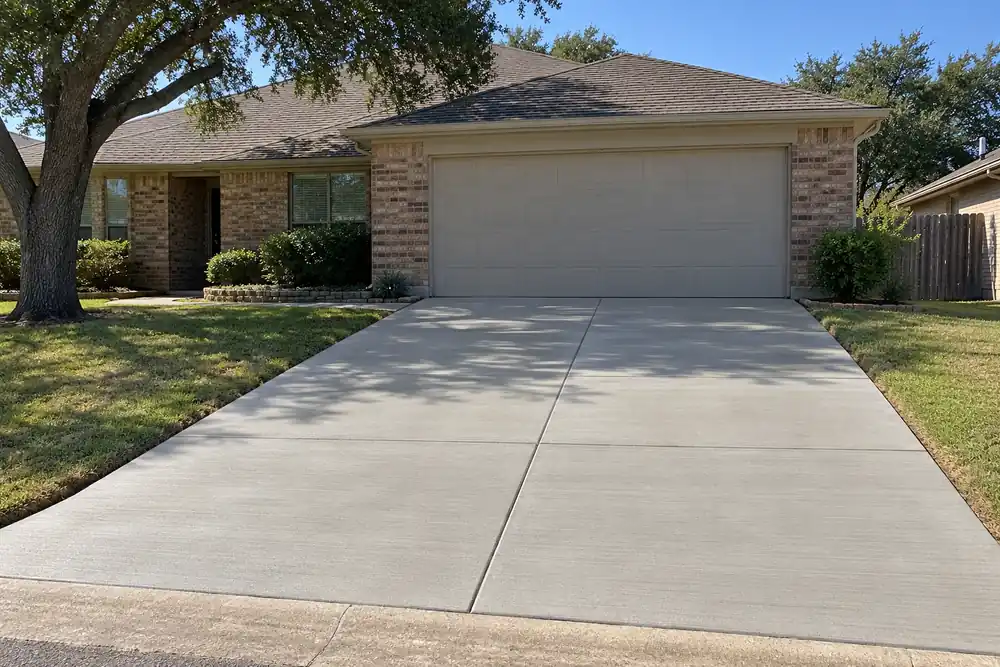
In Garland, the City allows two materials for front- and side-yard driveways: reinforced concrete or concrete pavers. A properly installed and maintained concrete driveway should last 30 years or longer, against a service life of about 15 years for asphalt. Dallas driveways, though, often reach their limit sooner than the 30 to 40 years a driveway might last in moderate conditions.
How thick should a concrete driveway be?
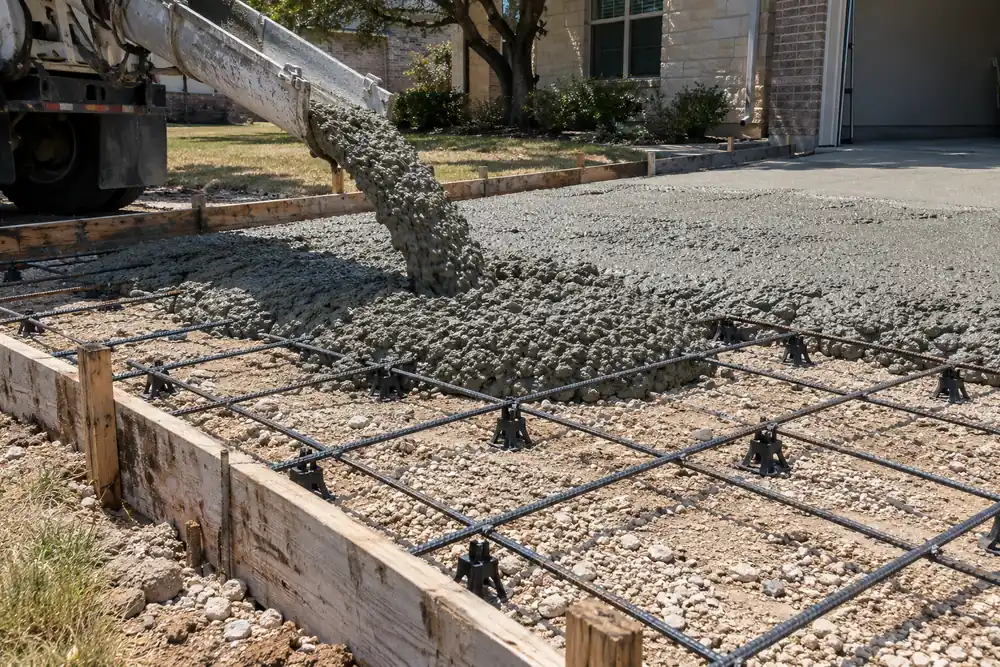
Garland's minimum is 4 inches of concrete with Number 3 rebar placed 18 inches on center on rebar chairs. For cars and SUVs of 3,000 to 6,000 pounds, 4 inches is generally enough, while trucks or large RVs of 12,000 pounds or more may call for 5 or 6 inches. According to the Tennessee Concrete Association, going from 4 to 5 inches adds about 20% to the concrete cost but boosts load capacity by nearly 50%. Garland Elite Concrete talks through thickness and reinforcement for how you'll use the driveway at the free estimate.
How wide does a driveway need to be in Texas?
In Garland, the City's Technical Standards Manual sets single-family driveway widths at the property line at 10 feet minimum and 24 feet maximum to a street, or up to 32 feet to an alley where the garage faces it, and allows one driveway onto a public street per lot unless a circular drive is approved. For planning, allow at least 10 feet of width per vehicle, with 12 feet preferred for a single driveway.
What is the average lifespan of a concrete driveway?
With proper maintenance, a quality concrete driveway should last 30 to 40 years, and some estimates run to 40+ years. Around Dallas, though, driveways often reach their limit sooner.
How soon can I drive on a new concrete driveway?
The general timeline: new concrete is okay to walk on after 48 hours; after 7 to 10 days it can carry a car, though not near or across the edges; after 30 days it can take all normal traffic except heavy commercial vehicles such as garbage trucks, and that is also a good time to seal it. RVs and large trucks should wait at least 28 days.
Can a damaged concrete driveway be repaired?
Yes, depending on the damage. Thin cracks of about ⅛ inch can usually just be repaired. Cracks or holes under ¼ inch can be filled or patched, though only as a temporary fix, and wider cracks, spalling and discoloration can be covered with resurfacing or an overlay. Once more than 25% of a driveway is damaged, resurfacing or replacement becomes the more cost-effective route.
Planning a driveway? Call or request a free estimate, 24/7.
(945) 441-5958Stamped and decorative concrete questions
What is the downside of stamped concrete?
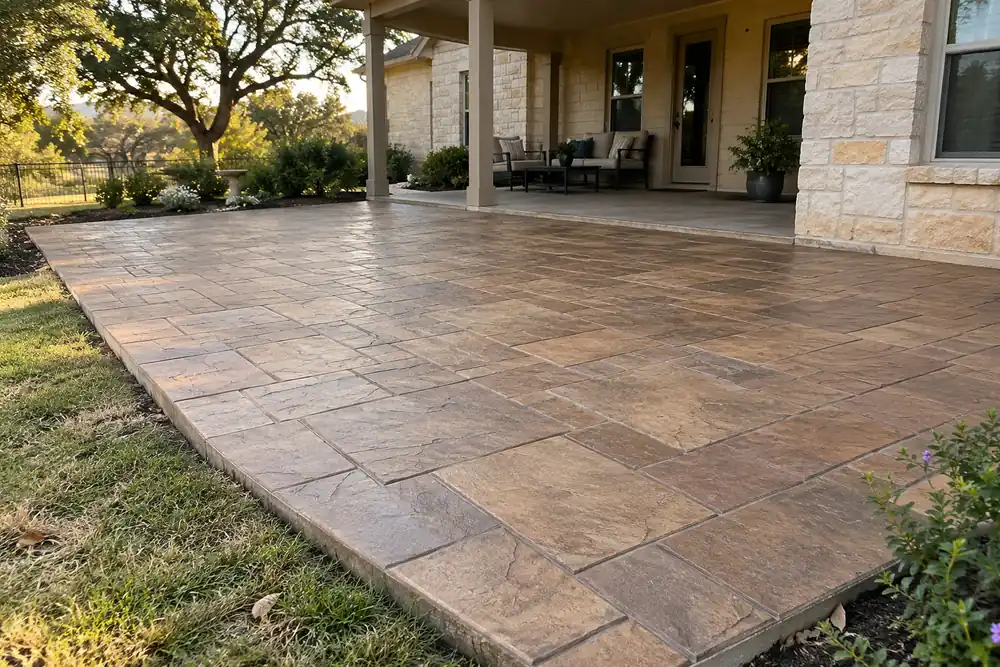
Compared with pavers, repairing and replacing stamped concrete is often more difficult and costly, and poured slabs may crack from encroaching tree roots, freeze-thaw cycles and other disturbances. Textured and stamped surfaces also drain more slowly, because water collects in the pattern, and stamped concrete typically needs resealing every 2 to 5 years. Some cracks come from the work itself: shrinkage cracks can form when stamps are pressed into concrete whose surface has already become too hard.
How long will stamped concrete last?
Anywhere from 25 to 50 years, depending on whether it's regularly resealed and well maintained. For properly maintained stamped concrete, 30+ years is a common estimate.
Is stamped concrete cheaper than pavers?
The installed prices overlap: stamped concrete typically runs $8 to $18 per square foot installed and concrete pavers $7 to $20, and both last 30+ years when properly maintained. Pavers take longer to lay because each unit goes down by hand, and the sand in their joints may need replenishing every 2 or 3 years to keep weeds out.
How is decorative concrete colored?
There are four common ways. Integral color is mixed into the whole batch and colors the entire slab, usually in earth tones and pastels. Color hardener is broadcast by hand onto the fresh surface and colors only the top layer, so its color tends to be more intense, and it also strengthens and densifies the surface. On stamped work, a secondary accent color generally makes up 5% to 30% of the final look. Stains go on after curing: an acid stain soaks in, reacts chemically with the concrete and stays translucent, while a water-based stain gives a more consistent color in dozens of standard shades. Applied to properly prepared concrete, stain color won't fade, chip or peel.
Planning a stamped or decorative finish? Call or request a free estimate, 24/7.
(945) 441-5958Concrete repair, leveling and resurfacing questions
What is the cheapest way to fix a cracked concrete driveway?
For small cracks, filling them. Nationally, concrete driveway crack repair runs $0.50 to $3 per linear foot. Epoxy filler suits cracks ⅛ inch wide or smaller, and cracks ½ inch or wider get a foam backer rod before they're filled. A patch on a crack under ¼ inch is only a temporary fix, though, and isn't watertight. Significantly wider cracks can point to a bigger problem in the slab, which is why Garland Elite Concrete looks at the crack and the concrete around it before pricing any concrete crack repair.
Do concrete crack fillers really work?
As a stopgap, yes. Any filled crack is a temporary repair, although some last many years, and patches aren't watertight. The Texas Department of Transportation says routing a V-shaped groove along a crack and sealing it can keep water out where a small amount of movement is expected. For cracks that affect strength, epoxy injection bonds to concrete more strongly than concrete's own tensile strength and can restore structural integrity in cracks 0.002 inch wide or wider, according to ACI 224.1R, but it may not be the best fix where the concrete is expected to keep moving.
Is mudjacking permanent?
Properly done mudjacking lasts 5 to 10 years or longer, though its slurry can wash away over time; polyurethane foam, which is waterproof and won't erode, lasts 10 to 15 years or longer. The International Association of Certified Home Inspectors says mudjacking isn't appropriate when a slab has risen from expansive soil or when the cause of the settling isn't addressed. Both are forms of concrete leveling, and the right one depends on the slab and the soil under it.
Does insurance cover concrete lifting?
Usually not. Homeowners insurance typically doesn't cover polyjacking, because concrete settling is considered normal wear and tear or a maintenance issue, unless it resulted from a covered event such as a plumbing leak.
What is the cheapest way to resurface a concrete driveway?
A basic overlay. Nationally, concrete resurfacing runs $3 to $7 per square foot, or $1,200 to $2,900 for a two-car driveway, against $6 to $20 for a decorative or stamped overlay, and it lasts 8 to 15 years before needing repairs. It suits sound concrete only: resurfacing is the fix for minor flaking or cracks under ¼ inch, concrete with large cracks, crumbling or structural problems should be replaced, and a driveway that is severely cracked or damaged should never be resurfaced.
Is sealing a concrete driveway worth it?
Sealing every few years with a high-quality product protects all concrete flatwork by keeping moisture out, and a driveway is usually due for resealing about every two years, or once the finish starts to wear. Nationally, sealing costs $1 to $3 per square foot installed, and a new driveway should cure 28 to 30 days before its first coat. Garland Elite Concrete gives free estimates for repair, leveling, resurfacing and sealing.
Cracked, sunken or worn concrete? Call or request a free estimate, 24/7.
(945) 441-5958Concrete slab and foundation questions
How thick should a concrete slab be?
The International Residential Code sets a 3½-inch minimum for concrete floors on the ground, with a separate section for expansive soils. House foundations are typically 6 inches thick, with steel rebar, a vapor barrier and foam insulation. The National Ready Mixed Concrete Association recommends a vapor retarder at least 10 mils thick under interior slabs, though it says one generally isn't needed under exterior slabs. Garland Elite Concrete talks through thickness and reinforcement for a concrete slab or foundation at the free estimate.
What is the purpose of a post tension slab?
The Post-Tensioning Institute describes post-tensioned slabs-on-ground as a cost-efficient, high-performance solution for foundations on shrink-swell soils: stressed steel tendons put the slab in compression, and that compression resists the tension soil movement creates. PTI also lists less concrete and steel for the same capacity, tighter cracks, and often faster installation than a rebar or wire-mesh slab. A typical residential post-tensioned slab is 8 inches thick, with 3,000 psi concrete and tendons 48 inches on center.
What happens if you drill into a post tension slab?
You risk cutting a tendon. Never cut or drill into a post-tensioned slab, because once a tendon has been cut it is very difficult to repair. The cables carry 25,000 to 33,000 pounds of force per strand, severing one releases that energy explosively, and any cutting or coring should come after ground-penetrating radar scanning.
Do you need a permit for foundation repair in Texas?
In Garland, yes, once the repairs cost $2,000 or more. The City's foundation repair permit costs $45 ($30 plus a $15 processing fee), and the application must include an engineer's letter. Outside Garland, check with the city where the house is.
Planning a slab or foundation? Call or request a free estimate, 24/7.
(945) 441-5958Commercial concrete questions
How thick does concrete need to be for a parking lot?
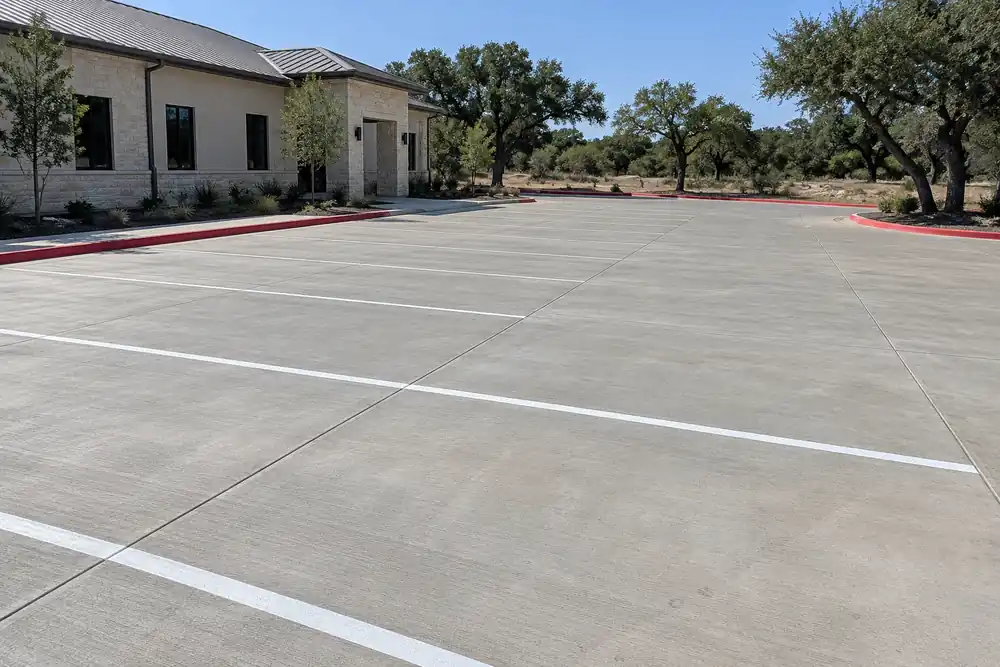
In Garland, a concrete parking lot must be at least 5 inches of reinforced concrete over an engineered subbase, according to the City's Technical Standards Manual, and fire lanes need at least 6 inches of reinforced Class P1 (4,000 psi) concrete. The National Ready Mixed Concrete Association's general guidance is that 4 inches of unreinforced concrete is usually satisfactory where only cars and pickups park, and that 5 or 6 inches may be needed for light trucks.
What strength concrete is used for commercial paving?
NRMCA says a 28-day strength of 4,000 psi is adequate for parking areas in most of the country, and the American Concrete Institute's parking lot specification, ACI SPEC 330.1-14, sets the same figure. Garland's Class P1 concrete, called for in fire lanes and residential driveway approaches, is 4,000 psi. Strength is checked with test cylinders, usually at 28 days. Garland Elite Concrete gives free estimates for commercial concrete paving, slabs, and curb and gutter.
What are the concrete things in parking lots called?
The raised concrete edges are curbs. Garland's Technical Standards Manual requires at least a 6-inch raised curb, or another device that stops cars, to separate parking from islands, sidewalks and other non-vehicle areas. NRMCA recommends a thickened edge on outer slabs that take wheel loads, which usually takes the form of an integral curb.
How long does a concrete parking lot last?
Estimates run 30 to 40 years, against 15 to 30 for asphalt, and the American Concrete Institute's parking lot guide says concrete lots typically have service lives of 20 years or more. ACI also notes that concrete lots run cooler than asphalt and are minimally affected by leaking petroleum products.
Planning a lot or a slab? Call or request a free estimate, 24/7.
(945) 441-5958Concrete cost questions
How much does a yard of concrete cost in Dallas, Texas?
Dallas ready-mix prices for 2026 run $125 to $155 per cubic yard for all-purpose concrete, $155 to $185 for high-strength and $175 to $200 for self-consolidating. The national average is $119 to $147 per cubic yard including delivery up to 20 miles, while the National Ready Mixed Concrete Association puts its average at $108.
How much is a 10 yard truck of concrete in Texas?
The figures we have are national. A full 10-yard truckload, delivered, costs $1,169 to $1,444 and is enough to pour a 20-by-24 driveway; an older 2024 figure put it at $900 to $1,500. Order less than 10 cubic yards and a short-load charge adds $53 per cubic yard.
How much is concrete per square foot in Texas?
It depends on the job. Nationally, most contractors charge $4 to $15 per square foot for standard flatwork and $8 to $25 or more for stamped or decorative work. Locally, 2026 Dallas figures put size-priced driveway projects at $5 to $10 per square foot and a new concrete slab at $4 to $8.
How much would a 20x20 concrete patio cost?
In the Dallas area, a 20-by-20 concrete patio runs $1,600 to $5,200 in 2026 figures, and the national figure for a basic 20-by-20 patio is $1,600 to $4,800. Stamped, the same 20-by-20 patio runs $3,200 to $7,600 nationally.
How much does concrete leveling usually cost?
Nationally, concrete leveling averages $1,235 in 2026 figures, with most homeowners paying $661 to $1,874. In Dallas, mudjacking averages $954, with most projects between $626 and $1,282. By the square foot, mudjacking runs $4 to $9 and polyurethane foam lifting $8 to $25 nationally.
Do you charge for an estimate?
No. Garland Elite Concrete gives free estimates for concrete work in Garland and nearby towns, and calls and estimate requests are answered 24/7. Published averages are a starting point; a real price depends on the size, the site, access, any old concrete to remove and the soil, which is why an estimate starts with a look at the job.
Want a price for your own job? Call or request a free estimate, 24/7.
(945) 441-5958Garland permits and local conditions
Do I need a permit to pour a driveway in Garland?
Yes, for a new driveway or to widen an existing one. The City's driveway permit costs $88 ($70 plus an $18 processing fee). The driveway approach in the City right-of-way needs its own Approach Permit, reviewed by the Transportation Department; its fee is set by the City, so confirm the current amount with Building Inspection at 972-205-2300. Garland Elite Concrete talks through what the City requires for your job at the free estimate.
Who is responsible for sidewalk repair in Texas?
In Garland, the property owner. The City's Street Department says that under City ordinance the abutting owner must keep the sidewalk, parkway, curb and driveway in good, safe condition, and the code gives an owner who receives a repair notice from the Streets Department 30 days to fix it, with exceptions along certain thoroughfares. The City helps through a cost-share program: when bond money is available it may split sidewalk reconstruction 50-50, with extra reductions for a homestead exemption, a Community Development Block Grant area, and owners who are disabled or 65 or older, down to as little as 10% for the owner. The Street Department runs it, at 972-205-2930.
Why does concrete crack in Garland?
Two reasons stack up. The most common soil mapped in Garland is Houston Black clay, which the USDA rates as having high shrink-swell potential; in dry periods it cracks ½ to 4 inches wide. And all concrete tends to crack: the National Ready Mixed Concrete Association says it isn't possible to produce completely crack-free concrete, and that most cracks come from design and construction mistakes such as missing joints, poor subgrade preparation, too much water, poor finishing, fast drying and little or no curing.
What cities are around Garland, TX?
Garland sits 15 miles northeast of downtown Dallas, with Lake Ray Hubbard on its eastern border, according to the Handbook of Texas, and the City describes itself as bordered by Interstate 635, Interstate 30 and the President George Bush Turnpike. Garland Elite Concrete works across Garland, Rowlett, Sachse, Richardson, Murphy, Sunnyvale, Wylie, Heath, Parker, St. Paul, University Park, Mesquite, Rockwall, Highland Park, Travis Ranch, Seis Lagos, Plano, Addison, Mobile City, Lucas, Balch Springs, Allen, Lavon, Farmers Branch, McLendon-Chisholm and Fate.
Still have a concrete question?
Call or send a request any time, 24/7. Estimates are free, and we'll answer questions about your own driveway, patio, slab or lot.