Concrete Sidewalks and Walkways in Garland, TX
Garland Elite Concrete pours concrete sidewalks and walkways in Garland, Texas: front walks, garden paths, side-yard walks, and new or replaced sections of the public sidewalk in front of a home. Under Garland's code, the owner next to a public sidewalk must keep it in good and safe condition, and when bond money is available the City may share the cost of rebuilding it 50/50.
Call or send the form for a free estimate. We'll talk through the route, the thickness, how the walk drains, and whether the City's permit and cost share apply.
Call or request a free estimate any time, 24/7
No charge · answered 24/7
Get free estimates
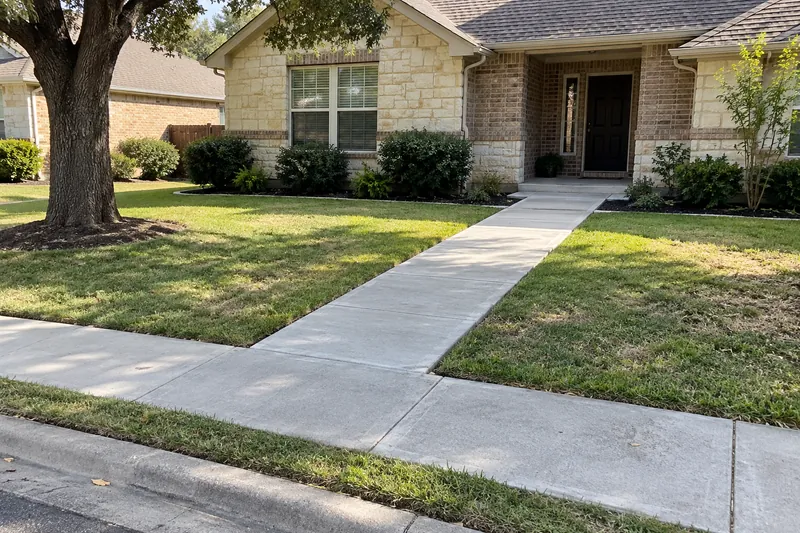
Concrete walkways for front yards, gardens and side yards
Thickness and base
A residential walkway should be poured at least 4 inches thick, over about 8 inches of excavation: 4 inches for a compacted gravel or crushed stone base and 4 inches for the concrete.
Slope and drainage
A 4-foot walkway running parallel to a house should drop 1 inch across its width, away from the house. The International Residential Code, adopted by Garland in its 2015 edition, requires paved surfaces within 10 feet of the foundation to slope at least 2 percent away from the building.
Joints and tree roots
Control joints are cut about every 4 feet across a sidewalk, to about a quarter of the slab's depth, and trees are best kept two sidewalk-widths away from the walk's edge to limit root uplift.
Steps and borders along a walk
Where a front walk meets porch steps, the stairs have to meet the building code's riser and tread limits, covered on our concrete steps page. Beds beside a path can be edged with concrete curbing, a continuous border extruded by machine that can follow any curve.
Call or request a free estimate any time, 24/7.
(945) 441-5958Garland's public sidewalk standard
The City's specification
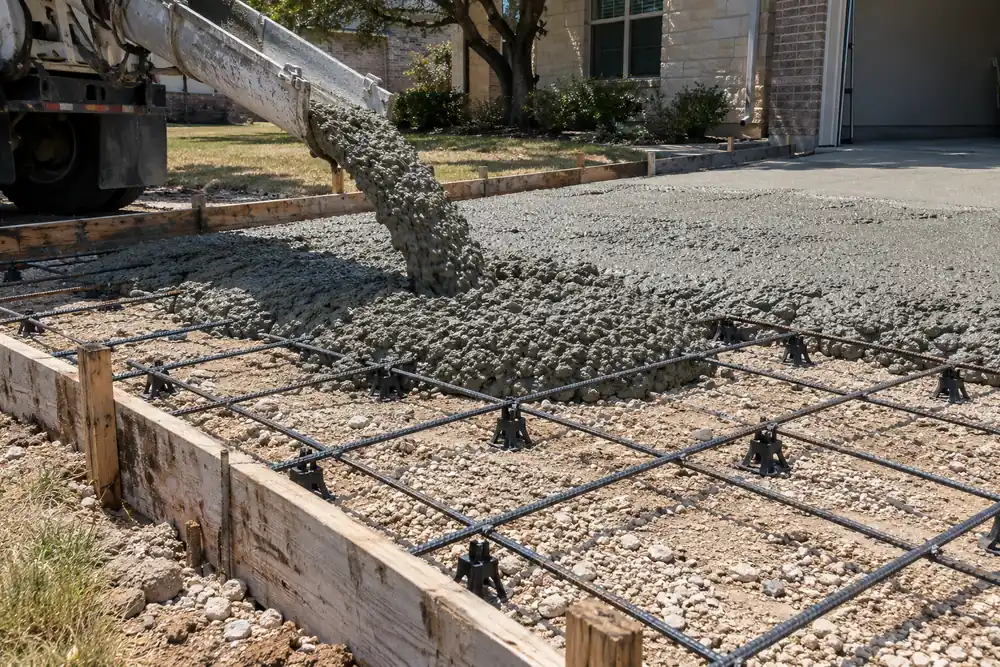
Garland's Driveway / Sidewalk page sets the standard at 4 inches of concrete with Number 3 rebar 24 inches on center on rebar chairs, kept at least 3 inches from each edge. The City's standard detail adds Class "C" concrete sloped 1% toward the street, ½-inch redwood expansion joints no more than 24 feet apart, tooled joints cut at least ½ inch deep, a white-pigmented curing compound and a cushion-sand leveling course no more than 2 inches thick. Its Technical Standards Manual limits the lengthwise grade to 5% or the grade of the street, whichever is greater, and the cross-slope to 2%.
Where the sidewalk crosses a driveway
The manual requires any sidewalk crossing a driveway to meet state and federal ADA accessibility rules; under the 2010 ADA Standards, a public walking surface is at least 36 inches clear, with a cross slope no steeper than 1:48. As general practice rather than a Garland figure, an Ohio industry recommendation notes that most codes thicken a 4-inch public sidewalk to 6 inches across driveways. The approach itself is covered on our driveway aprons page.
Garland Elite Concrete can price your sidewalk against the City's standard in a free estimate.
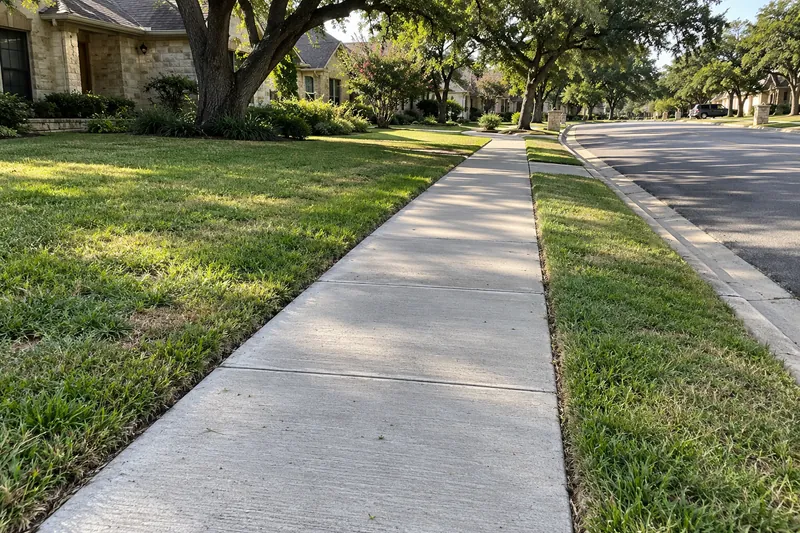
- Tooled joint at least ½ in. deep (City of Garland)
- White-pigmented curing compound (City of Garland)
- 4 in. Class C concrete, 1% slope to the street (City of Garland)
- #3 bars, 24 in. on center each way, on chairs (City of Garland)
- Cushion-sand leveling course, 2 in. at most (City of Garland)
- Houston Black clay, "Very limited" for sidewalks (USDA)
Call or request a free estimate any time, 24/7.
(945) 441-5958Sidewalk repair and replacement
Why sidewalks heave and crack here
Houston Black clay is the most common soil mapped inside Garland's city limits, and the USDA soil survey rates it "Very limited" for concrete driveways and sidewalks because of high shrink-swell. The region's Blackland Prairie clay swells when wet and shrinks when dry, making slabs heave, crack and shift, and in the Dallas area a geotechnical assessment for $200 to $500 may be worthwhile.
When a section has to be fixed
Garland's code counts a sidewalk as hazardous when adjoining sections or crack edges differ in height by 2 inches or more, a gap reaches 1½ inches or more, or the cross-slope exceeds 5 percent. The City's engineering standards call for replacing sections whose cracks or joints are ¾ inch or more out of line vertically, or ¾ inch or more apart, with any tree roots causing the problem cut out. A defective sidewalk must be repaired within 30 days of a City notice.
Lifting, patching or pouring again
A slab that sank because its base eroded can sometimes be raised back by slabjacking, often a good fix for smaller slabs such as sidewalks, while a slab pitched the wrong way usually has to be removed and replaced. Replacement costs more than a new pour because of tear-out, disposal and fixing whatever caused the damage. Crack and slab repair is covered on our concrete repair page.
Permits, the sidewalk bond and the City's cost share
Any repair to the public sidewalk needs a City permit; the private walk up to the front door doesn't. Whoever does public sidewalk work must have a Sidewalk Bond on file: under the City's code, a $2,000 bond with a two-year maintenance obligation. When bond money is available, the City shares reconstruction costs 50/50 with residential owners, with an extra 15% off for a homestead exemption, 15% in a Community Development Block Grant area and 10% for owners who are disabled or 65 or older, so an owner who qualifies for all three may pay as little as 10 percent. Our guide to Garland sidewalk permits covers the forms and contacts.
Call or request a free estimate any time, 24/7.
(945) 441-5958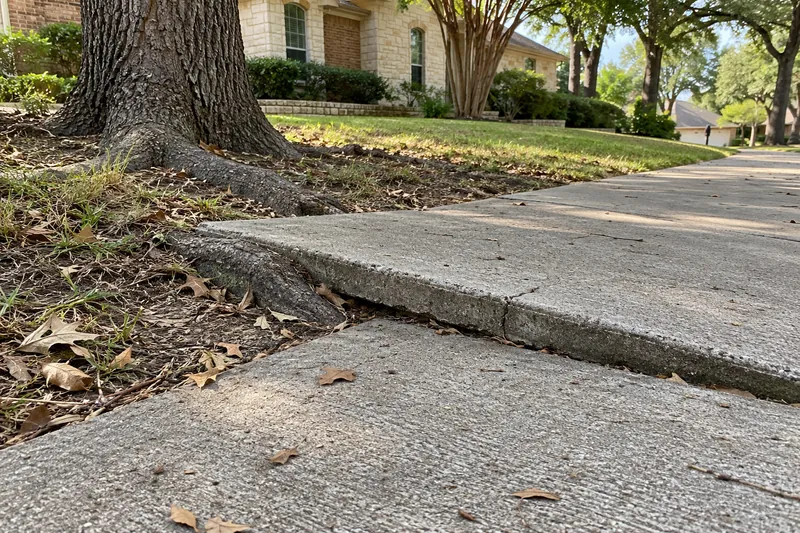
Sidewalk and walkway cost in the Dallas area
In 2026 Dallas-area figures, a concrete walkway averages $2,062, with most projects between $1,650 and $2,474, and a pro charges $8 to $23 per square foot. Dallas-area sidewalk repairs run $5 to $15 per square foot, averaging $1,168, with $100 to $230 per ton for concrete disposal.
On a public sidewalk, the City's cost share changes the math: its worked example shows a $1,000 sidewalk costing an owner who qualifies for every reduction $100. These are published figures, not prices from Garland Elite Concrete, and your estimate is free.
- 100 sq ft, 4 in. thick
- $825–$1,235
- 100 sq ft, 6 in. thick
- $930–$1,340
- 200 sq ft, 4 in. thick
- $1,650–$2,475
- 200 sq ft, 6 in. thick
- $1,855–$2,680
Typical Dallas-area walkway prices, 2026. Averages, not a quote.
Call or request a free estimate any time, 24/7.
(945) 441-5958Sidewalk and walkway questions
How wide should a sidewalk be?
For a home walkway, 48 inches is the ideal width, enough for a wheelchair or two people walking side by side; garden paths work well at 4 to 5 feet, and walks under 3 feet are best avoided. Garland's standard public sidewalk is 4 feet wide for residential and 6 feet for commercial, and the City's manual calls for at least 6 feet along its larger thoroughfares.
How long does a concrete sidewalk last?
A concrete sidewalk typically lasts 20 to 40 years, and some estimates put the average at 25 to 50 years. Walkways need proper expansion joints to prevent cracking and should be resealed every 2 to 3 years.
Can a sidewalk be stamped or colored?
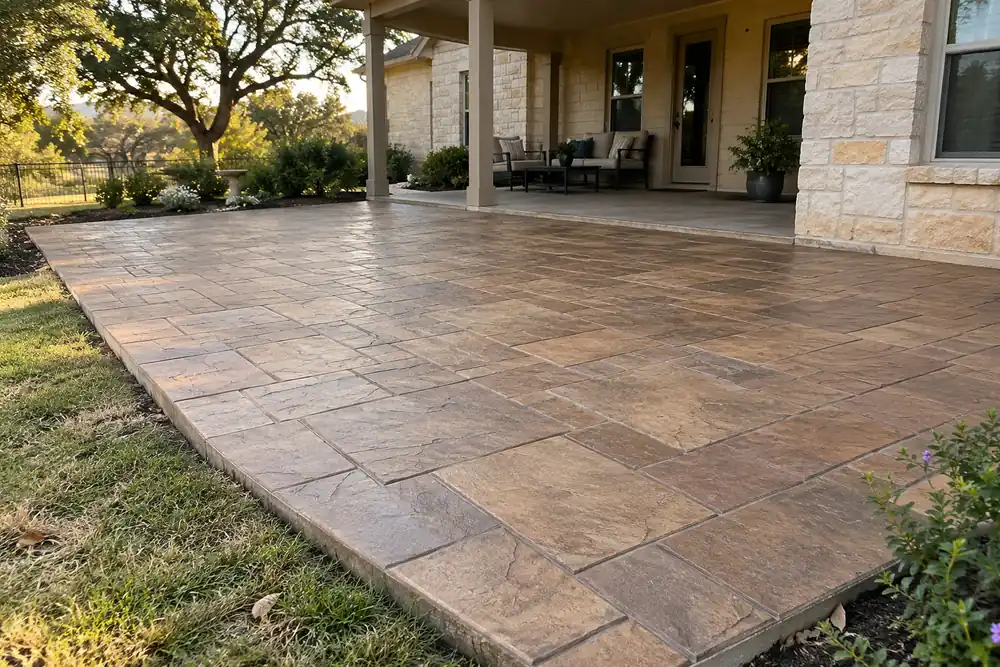
On a private walk, usually yes. Most municipalities don't allow finishes like stamped, polished or colored concrete on public sidewalks, but they're usually fine on private residential paths. In 2026 Dallas-area prices, standard flat concrete runs $8 to $12 per square foot and stamped $9 to $23.
Can a sunken sidewalk be lifted instead of replaced?
Sometimes. Slabjacking lifts a sunken slab back to level by pumping a grout mix or foam beneath it, and traditional mudjacking often costs less than half as much as replacing the slab. InterNACHI, a home-inspector association, lists when mudjacking isn't appropriate, including a spalling or damaged surface, a slab that has risen from expansive soil, and a cause of settling that isn't addressed. In DFW, poly-foam slab lifting typically runs $8 to $20 per square foot.
How soon can you walk on a new sidewalk?
Wait at least 24 hours before walking on new concrete; the whole curing period takes about 28 days. The Michigan Concrete Association's guidelines let a driveway or sidewalk open to traffic after 7 days of curing, or sooner when tests show it has reached 2,500 psi.
Free estimates for sidewalks and walkways
Garland Elite Concrete answers calls and estimate requests 24/7 for new walkways, front walks and sidewalk replacement in Garland and nearby towns. Tell us how long the walk is and what's there now.