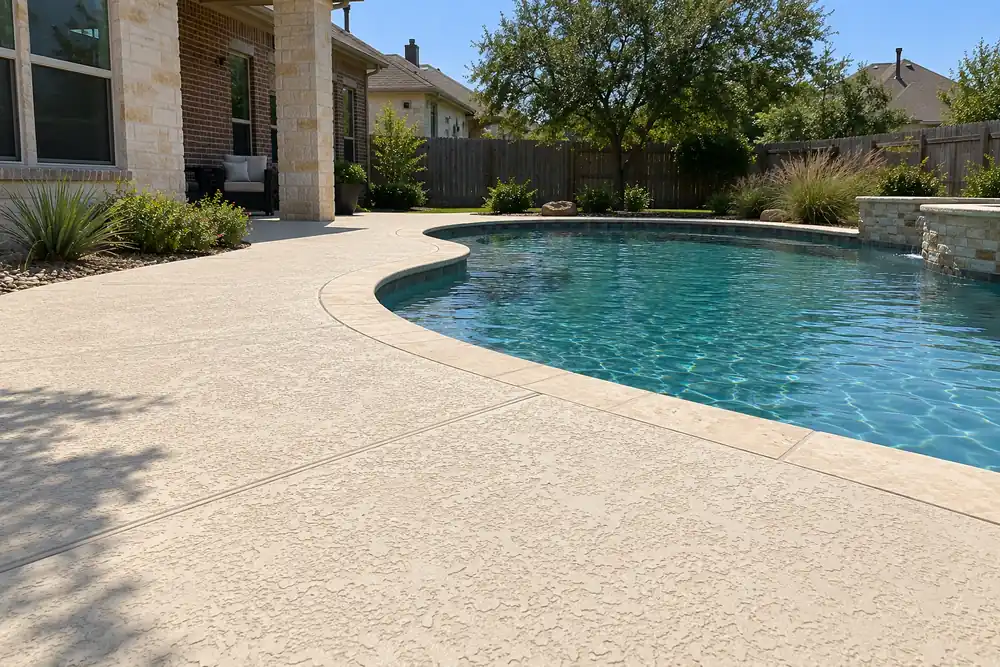
Concrete Patios in Garland, TX
Garland Elite Concrete builds concrete patios and patio extensions in Garland, Texas, from a plain broom-finished slab off the back door to stamped, stained or exposed aggregate designs. According to the Census Bureau's 2020-2024 American Community Survey, 58,992 of Garland's 86,216 housing units are single-family detached homes.
Call or send the form for a free estimate. We'll talk through the size and shape, the finish, the slope away from your house and the base your soil calls for.
Call or request a free estimate any time, 24/7
No charge · answered 24/7
Get free estimates
Patio finishes: broom, stamped, stained and exposed aggregate
A patio slab can be finished several ways, and the finish decides the look, the grip underfoot and the upkeep.
Broom and smooth finishes
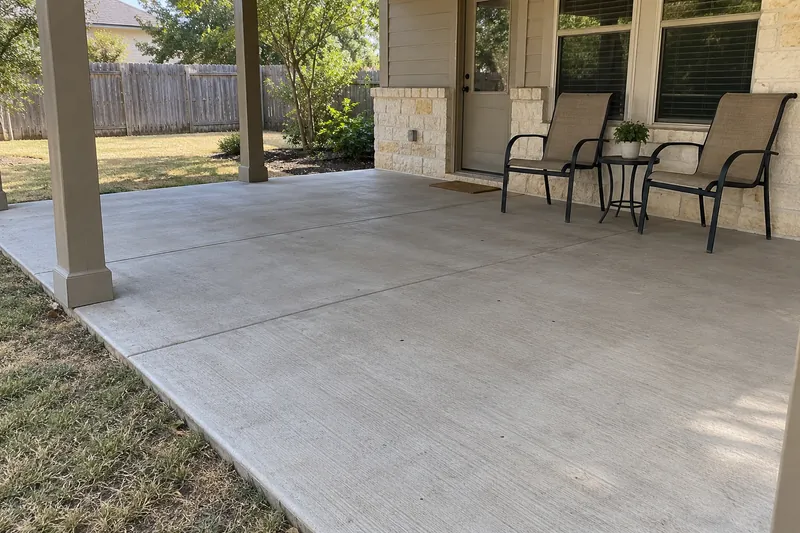
The National Ready Mixed Concrete Association (NRMCA) says exterior flatwork such as patios should be textured with a push broom after floating, to give a non-slip surface. It also warns finishers never to sprinkle water or cement on the concrete to make finishing easier, because that causes dusting or scaling.
Decorative finishes
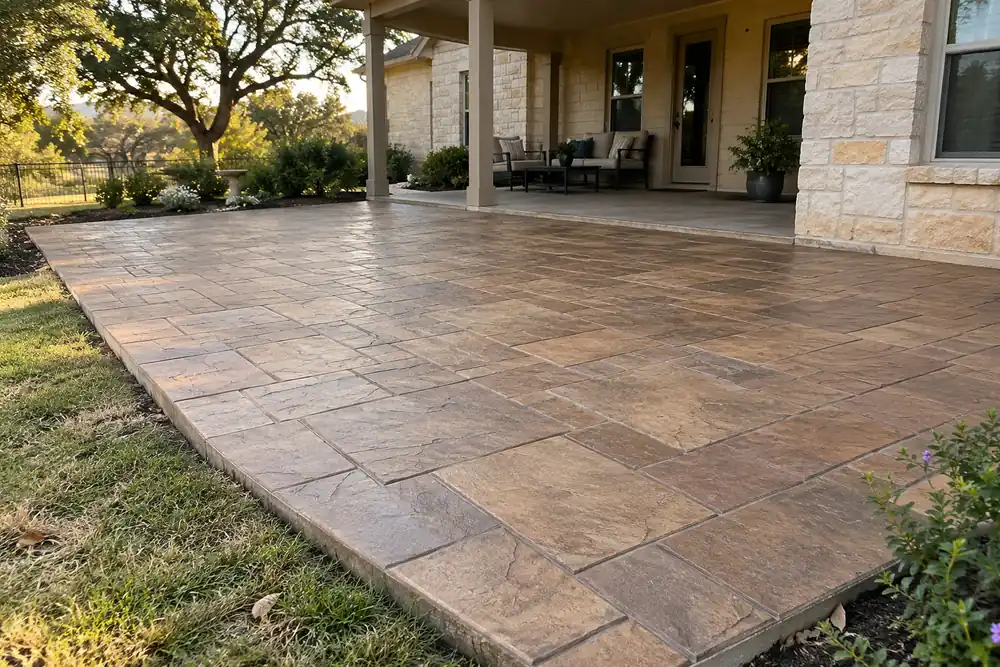
Stamped concrete presses a pattern into the fresh slab, with color mixed through the batch or spread on the surface as a color hardener, which gives a more intense color. Stained concrete works differently: a true acid stain is translucent, soaks into the surface and leaves no film or coating. Exposed aggregate brings stones from 3/8 inch to 2 inches or more to the surface for a rugged, nonskid finish, and a patio finished this way, cared for properly, is expected to last at least 50 years without needing repair.
Patios beside a pool
Around a pool, a brushed or broom finish adds slip-resistant texture, and exposed aggregate is especially well suited because it is highly slip resistant. Our concrete pool decks page compares the options.
Patio extensions
Nationally, a concrete patio extension typically costs $4 to $30 per square foot, the same as a new patio, because the area still needs grading and a sand or gravel base. NRMCA uses isolation joints to separate patios from sidewalks, garage slabs, stairs and other fixed points, so each part can move on its own. Outside the city, Garland Elite Concrete also builds concrete patio extensions in Sachse.
Call or request a free estimate any time, 24/7.
(945) 441-5958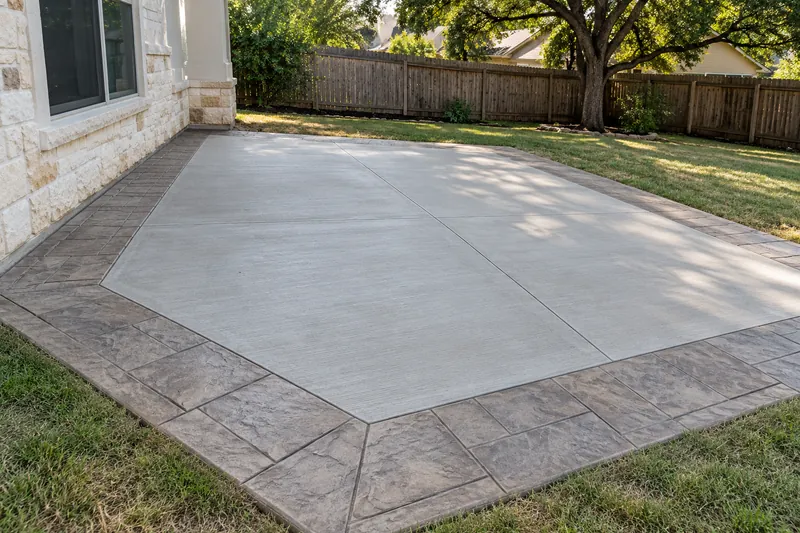
Patio thickness, slope and joints
How thick a patio should be
A patio is generally poured at least 4 inches thick, going to 5 to 6 inches under heavy loads such as a hot tub or an outdoor fireplace.
Slope away from the house
The International Residential Code, adopted by Garland in its 2015 edition, requires paved surfaces within 10 feet of the foundation to slope at least 2 percent away from the building. A 2% slope works out to a ¼-inch drop per foot, so a patio reaching 10 feet from the house drops 2½ inches, and stamped or textured surfaces drain more slowly because water collects in the pattern. Where the back door sits above the patio, the same code limits stair risers to 7¾ inches and requires treads at least 10 inches deep; our concrete steps page covers them.
Joints and reinforcement
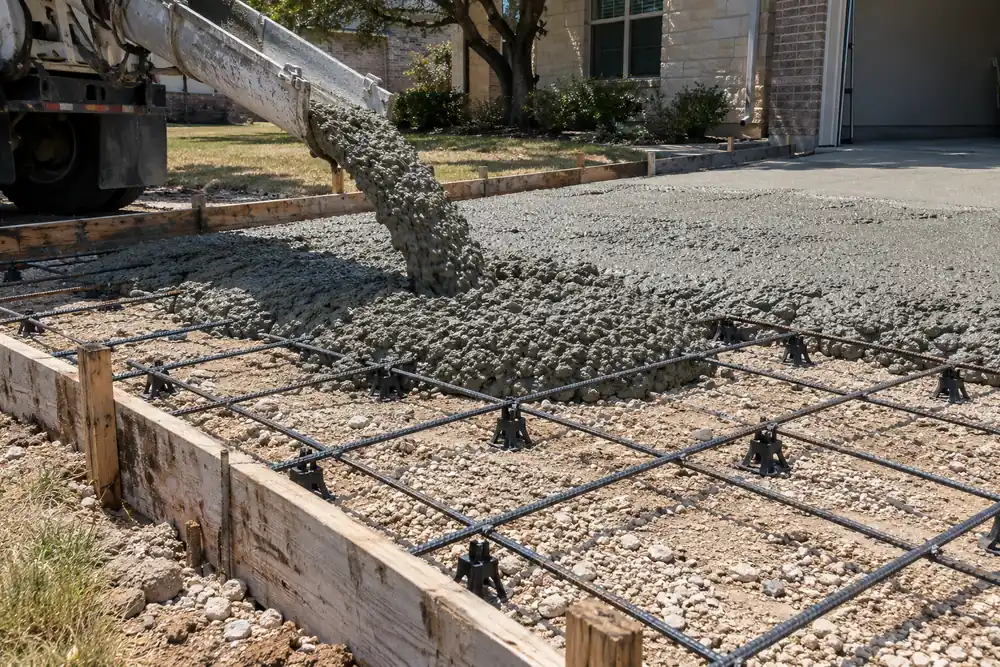
NRMCA spaces contraction joints 24 to 36 times the slab thickness, about 10 feet for a 4-inch slab and never more than 15 feet, cut at least a quarter of the slab deep and never less than 1 inch. It keeps panels square or nearly so, no longer than 1.5 times their width, and avoids L-shaped panels. Rebar or wire mesh can't prevent cracking, but properly placed reinforcement limits crack width, and to do that the steel must sit at or just above mid-depth.
- Contraction joint at least ¼ of the slab depth (NRMCA)
- Broom texture for a non-slip surface (NRMCA)
- 4 in. minimum; 5 to 6 in. under a hot tub
- Rebar or mesh at or just above mid-depth
- Subbase and base at least 4 in. in total
- Houston Black clay, high shrink-swell (USDA)
Call or request a free estimate any time, 24/7.
(945) 441-5958Clay soil, heat and Garland patio rules
Houston Black clay
Houston Black clay is the most common soil mapped inside Garland's city limits. The USDA describes it as having high shrink-swell potential, with cracks ½ to 4 inches wide, down to 12 inches or more, in dry periods, and its soil survey rates it "Very limited" for concrete driveways and sidewalks, a rating it applies to reinforced slabs 3 to 6 inches thick. Expansive clay calls for good compaction first, then drainage, and poor subgrade preparation is among the most common reasons home slabs fail early. Ask Garland Elite Concrete and we'll talk through the base and drainage your yard needs.
Pouring in summer heat
Normal highs at DFW Airport are 95.6°F in July and 95.8°F in August (1991-2020 normals). NRMCA ties plastic shrinkage cracks to wind over 5 mph, low humidity and high temperatures, advises avoiding the hottest part of the day, and calls for curing at least 3 days.
Permits and HOA approval
A patio or porch cover, attached or freestanding, needs a City of Garland building permit, at $0.52 per square foot (minimum $100) plus a 25% processing fee (minimum $25). The City's pages list no separate permit for a plain patio slab, so call Building Inspection at 972-205-2300 before work starts. City approval doesn't replace any HOA approval.
Beyond the city line, Garland Elite Concrete also pours concrete patios in Murphy.
Call or request a free estimate any time, 24/7.
(945) 441-5958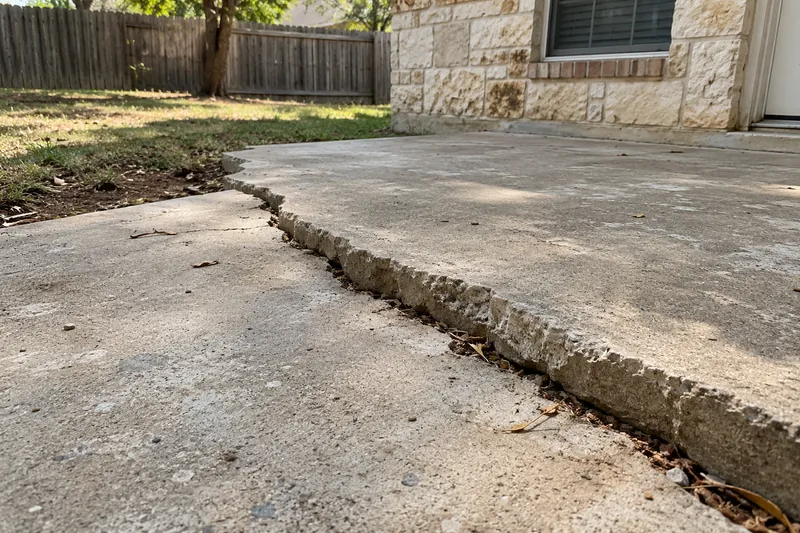
Concrete patio cost in the Dallas area
In 2026 Dallas-area figures, a concrete patio runs $1,718 to $4,095, with most homeowners spending $2,854, and installation costs $4 to $13 per square foot. Labor typically makes up 40% to 60% of the total, and site work adds to it: $1,000 to $3,300 to level or regrade a hilly site, and $550 to $1,700 on average to remove old concrete.
These are published averages, not prices from Garland Elite Concrete. A real number needs a look at your yard, and the estimate is free.
- 10 × 10 ft (100 sq ft)
- $400–$1,300
- 12 × 12 ft (144 sq ft)
- $580–$1,870
- 16 × 20 ft (320 sq ft)
- $1,280–$4,160
- 20 × 20 ft (400 sq ft)
- $1,600–$5,200
What patios typically cost around Dallas, 2026 figures. Averages, not a quote.
Call or request a free estimate any time, 24/7.
(945) 441-5958Patio questions homeowners ask
What can I put on my concrete patio to make it look better?
A fresh coat of stain or a stamped overlay every 10+ years can keep a patio looking new. A stamped overlay goes on 1/4 to 3/4 inch thick, but it may not be viable over large cracks, significant spalling or severe settlement. Acid stain changes the color without a coating, though Brickform's data sheet warns that its stain will not hide discoloration, blemishes or cracks.
How can I extend my existing concrete patio?
The extension is poured as a new slab against the old one. For joints between old and new pavements, the American Concrete Pavement Association uses isolation joints ½ to 1 inch wide, filled full depth with a pre-formed joint filler. Getting new concrete to match the color of the existing slab can be a challenge. The new section still has to slope away from the house like the original.
What is the cheapest way to extend a patio?
Among concrete finishes, a smooth or trowel finish is the lowest-priced in 2026 Dallas-area figures, at $4 to $12 per square foot, against $6 to $13 for broom, $7 to $18 for exposed aggregate, $8 to $25 for stained and $9 to $30 for stamped.
How long does a concrete patio last?
With proper care, a concrete patio can go 30+ years without major repairs, and with regular maintenance 30 to 50 years is a common estimate. A high-quality sealer every few years benefits all concrete flatwork by blocking moisture.
How much concrete do I need for a patio?
The usual rule is thickness in feet times width times length, divided by 27, for cubic yards. For example, a 12 by 12 foot patio 4 inches thick takes about 1.78 cubic yards of ready-mix concrete. A patio carrying a hot tub, poured 5 to 6 inches thick, takes more.
Plan your new patio with a free estimate
Garland Elite Concrete answers calls and estimate requests 24/7 for new patios, patio extensions and decorative finishes in Garland and nearby towns. Tell us the size you have in mind and what's there now.