8 Things to Check Before Hiring a Commercial Concrete Contractor in Garland, TX
Garland Elite Concrete put together these eight checks for anyone hiring a commercial concrete contractor in Garland, Texas, from City registration and right-of-way bonds to the mix strength, thickness and jointing a parking lot needs.
Garland has more than 30 million square feet of industrial space, with a vacancy rate of about 4%, according to a City of Garland news release from August 2026, and its core industrial district lies in the southwest of the city. Whether the job is a warehouse slab, a new lot or commercial concrete repair, these are the questions to put to every bidder.
Call or request a free estimate any time, 24/7
Registration and bonding for commercial work in Garland
1. City contractor registration
Garland requires general contractors, concrete contractors included, to register with Building Inspection. Registration costs $125, and every application needs proof of insurance and the owner's or principal's driver's license. The City's Building Permit page says all work must be done by state-licensed trades (mechanical, electrical, plumbing and irrigators) and City-registered contractors. At the state level, the Texas Attorney General tells people to check a license when the trade is one the state licenses, such as an electrician, and the Texas Department of Licensing and Regulation's program list, checked for this guide in September 2026, includes electricians and air conditioning contractors but shows no program for general or concrete contractors. Ask each bidder for its Garland registration.
2. Right-of-way registration and bonds
If the job reaches the street, with a new drive approach, curb and gutter or a sidewalk along the frontage, more rules apply. Garland's code bars anyone from building or repairing a curb, gutter, driveway or other concrete on public property without the needed permits, including a Right-of-Way Permit and a Sidewalk and Driveway Approach Permit. The right-of-way work permit comes from Engineering's Field Operations Group, and contractors doing that work must register with the City's Right-of-Way Management Department, at $400 a year with a certificate of insurance naming the City; since January 1, 2025, a General Repair Bond is no longer accepted in place of insurance. Sidewalk work also needs a $2,000 bond that obliges the contractor to maintain the work for two years.
Planning commercial concrete work? Call or request a free estimate, 24/7.
(945) 441-5958
Commercial concrete specs to ask about
A bid should say what it's pricing. These three specs are worth seeing in writing.
3. Mix strength and cylinder tests
The National Ready Mixed Concrete Association says a 28-day strength of 4,000 psi is adequate for parking areas in most of the country, and the American Concrete Institute's specification for unreinforced parking lots, ACI SPEC 330.1-14, sets the same 4,000 psi. Garland's Technical Standards Manual defines its Class "P1" concrete as 4,000 psi. Strength is proven with test cylinders: NRMCA says acceptance is usually judged at 28 days, with 7-day tests only an early indication, and concrete meets its specified strength when the average of three consecutive tests equals or exceeds it and no single test falls more than 500 psi below it. Ask who will cast and test the cylinders.
4. Thickness and reinforcement to Garland's standard
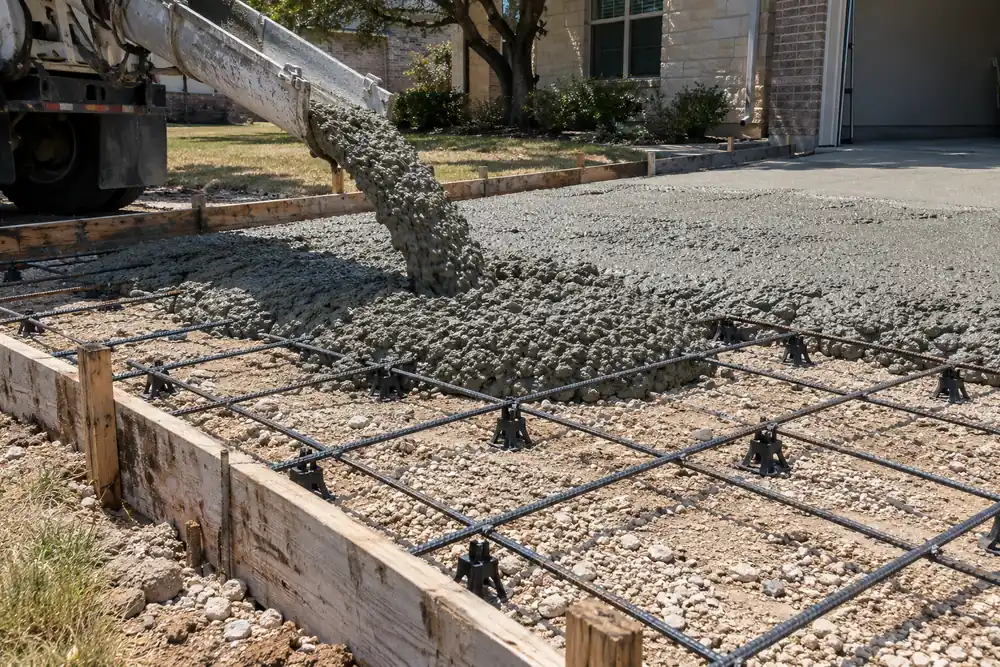
Garland sets the minimum for a concrete parking lot: at least 5 inches of reinforced concrete over an engineered subbase. Fire lanes must be at least 6 inches of reinforced Class P1 concrete, and the City's site-plan checklist gives them a 24-foot width. For comparison, the ACI 330 thickness table that NRMCA reprints calls for 4.0 inches in car parking areas and 8.0 inches in truck entrance lanes carrying 700 multiple-unit trucks a day, on weak subgrade. Welded wire mesh adds no structural capacity, NRMCA notes; its job is to keep cracks tight.
5. Joint layout and drainage
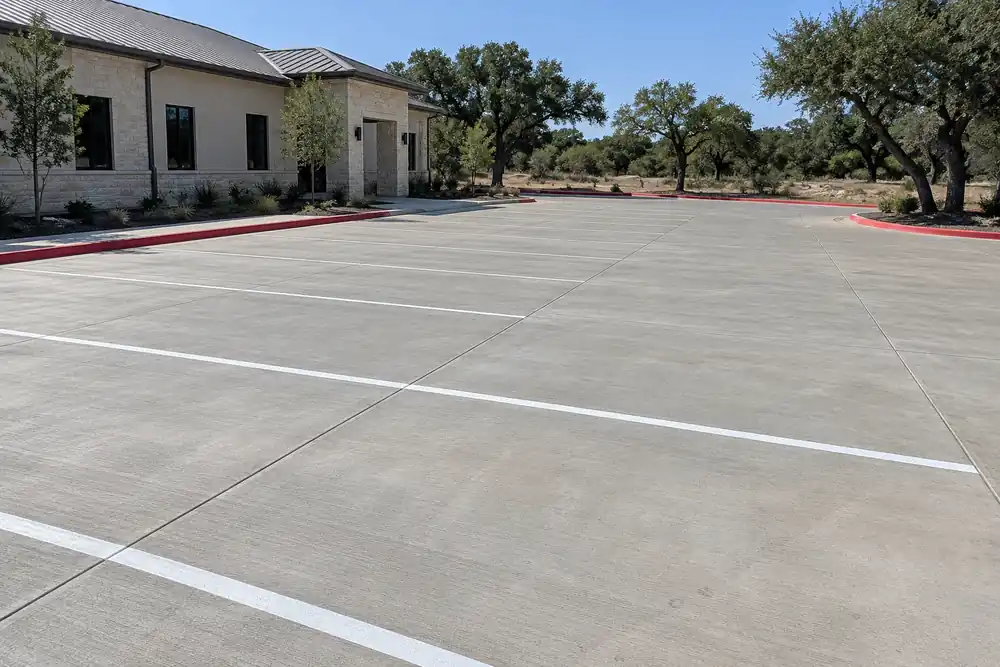
NRMCA's parking-lot guide spaces joints no more than 24 to 30 times the pavement thickness, with a 15-foot maximum, in panels that are square where possible and never more than 1.5 times as long as they are wide. Contraction joints are cut at least one-fourth of the slab depth, and full-depth isolation joints are used only around fixed objects. Pavement should slope 1%, or ⅛ inch per foot, toward drains, and outer slabs that take wheel loads get a thickened edge, usually in the form of an integral curb.
Call or request a free estimate any time, 24/7.
(945) 441-5958Planning for clay subgrade and Texas heat
6. A plan for the subgrade and hot-weather pours
The most common soil mapped in Garland is Houston Black clay, which the USDA soil survey rates "Very limited" for dwellings on a concrete slab because of high shrink-swell. NRMCA says a concrete parking lot needs no special subbase, but the subgrade's soil type, moisture content and density must be uniform, so ask how the bidder will prepare and check it. Heat is the other risk. DFW averages 20 days a year at 100°F, according to the National Weather Service, and the American Concrete Institute limits concrete to 95°F at the time it's discharged from the truck. NRMCA says concrete cured at high temperatures early on ends up weaker at later ages than the same concrete cured around 70°F, and ACI's hot-weather guide says test cylinders cured at 100°F for their first 24 hours may test 10 to 15 percent lower at 28 days. On major projects, NRMCA recommends a pre-construction conference of the supplier, owner, designers, contractors and testing agencies to settle who does what.
Call or request a free estimate any time, 24/7.
(945) 441-5958Parking lot accessibility and site-plan details
7. ADA and City site-plan rules
Garland's Technical Standards Manual requires at least a 6-inch raised curb, or another device that stops cars, to separate parking from islands, sidewalks and other non-vehicle areas, and its site-plan checklist shows a typical 90-degree stall 9 feet wide by 18 feet deep, with a 24-foot aisle. Refuse enclosures get a 12-by-16-foot concrete pad 6 inches thick, and barrier-free ADA ramps are required across any non-residential or multi-family driveway. Under the 2010 ADA Standards, accessible car spaces are at least 96 inches wide and van spaces 132 inches, access aisles are at least 60 inches wide, and aisles sit level with the spaces they serve, with slopes no steeper than 1:48. The minimum count starts at 1 accessible space for a lot of 1 to 25 spaces, 2 for 26 to 50, 3 for 51 to 75 and 4 for 76 to 100, and at least one in six must be a van space.
Call or request a free estimate any time, 24/7.
(945) 441-5958Comparing commercial concrete bids
8. Written bids, references and payment
The Texas Attorney General's consumer advice is written for homeowners, but its basics apply just as well to a business hiring for a lot: get bids in writing from more than one contractor, be wary of a "low-ball" bid, and ask for references. The Attorney General also warns that if a contractor fails to pay subcontractors or suppliers, the owner can be held responsible and the property may face a lien, so ask each bidder how suppliers and subcontractors get paid.
Average prices help you spot a bid that's far off. In 2026 national figures, a concrete parking lot runs $5 to $10 per square foot, or $1,500 to $3,500 per stall, with most lots taking 300 to 350 square feet per car, and installation takes 2 to 4 weeks. A second 2026 national estimate puts concrete paving at $4 to $7 per square foot.
- Per square foot, higher estimate
- $5–$10
- Per stall
- $1,500–$3,500
- Per square foot, lower estimate
- $4–$7
- Space per car
- 300–350 sq ft
Two 2026 national estimates. Averages, not a quote.
Call or request a free estimate any time, 24/7.
(945) 441-5958Commercial concrete questions
How long does a concrete parking lot last?
A concrete parking lot generally lasts 30 to 40 years, against 15 to 30 years for asphalt. The American Concrete Institute's parking lot guide says concrete lots typically have service lives of 20 years or more.
How soon can cars and trucks use a new concrete lot?
NRMCA says to keep cars off new parking pavement for 3 days and trucks for 7 days, unless tests show the concrete has gained adequate strength, which is usually 3,000 psi.
Is concrete or asphalt better for a parking lot?
It comes down to budget and lifespan. Concrete is the pricier of the two, but it lasts 30 to 40 years where asphalt lasts 15 to 30. The American Concrete Institute adds that concrete lots run cooler than asphalt and are minimally affected by leaking petroleum products.
Get a free commercial concrete estimate
Call or send a request any time, 24/7, with the size of the lot or slab and any plans or specifications you have, for a free estimate.