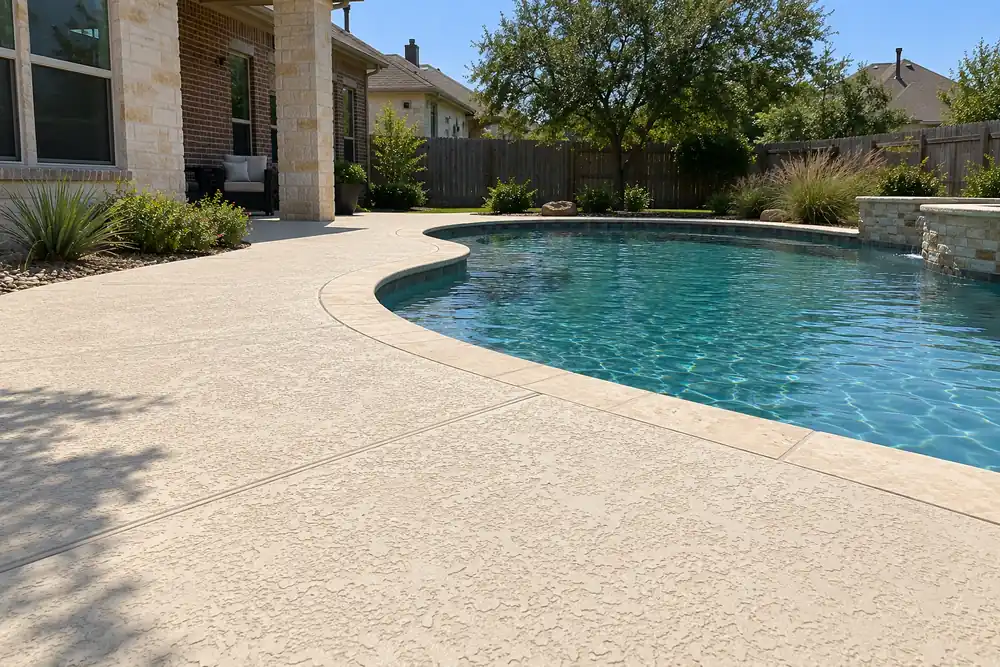
Concrete Basketball Courts in Garland, TX
Garland Elite Concrete pours concrete basketball courts in Garland, Texas, from a backyard half-court slab to a full-size court, with the slope, joints and base a playing surface needs. The American Sports Builders Association (ASBA) recommends a soil analysis to catch problems such as expansive soils, and the most common soil mapped in Garland is Houston Black clay, which the USDA describes as having high shrink-swell potential.
Call or send the form for a free estimate. We'll talk through the court's size, the base and drainage, and how it meets your driveway or patio.
Call or request a free estimate any time, 24/7
No charge · answered 24/7
Get free estimates
Court sizes, lines and hoop height
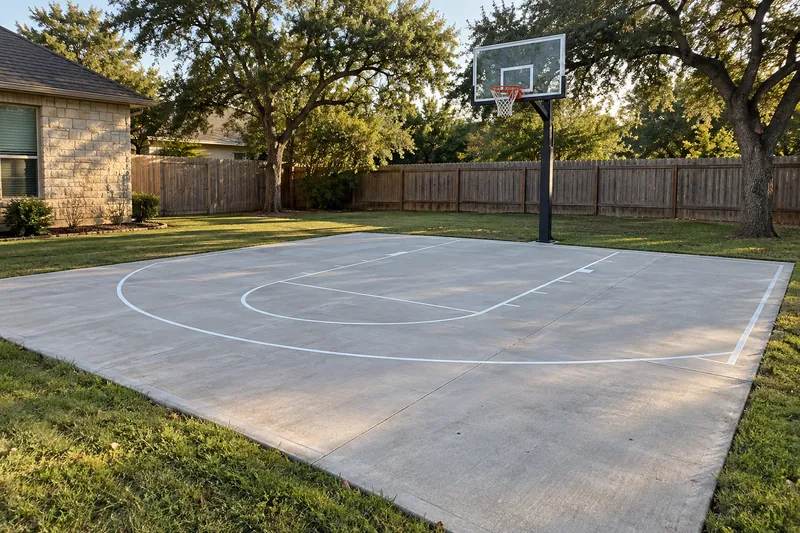
An NBA/NCAA regulation full-size court is 94 feet long and 50 feet wide. NBA rules set the rim 10 feet above the floor, the free-throw line 15 feet from the face of the backboard, and the three-point arc 23 feet 9 inches from the middle of the basket, with straight lines 3 feet in from the sidelines.
Half-courts and single-hoop slabs
A 30-by-30-foot half-court is a compact size that suits home use. For one hoop over a smaller slab, see our concrete pads page.
Where the court meets the yard
The ASBA recommends a finished subgrade 4 to 6 inches above the surrounding ground. Where the court meets a driveway or a concrete patio, VersaCourt, a court-surface maker, calls for an expansion joint wherever new concrete abuts new or existing concrete.
Call or request a free estimate any time, 24/7.
(945) 441-5958Court slab mix, reinforcement and joints
ASBA guidelines
The ASBA guidelines call for court concrete with a compressive strength of at least 3,000 psi and a slump of no more than 4 inches. The guidelines set a thicker slab where freeze-thaw cycles repeat; for local context, DFW Airport averages 29 freeze days a winter (1991-2020 normals), and we'll talk through which applies to your court.
A court maker's base spec
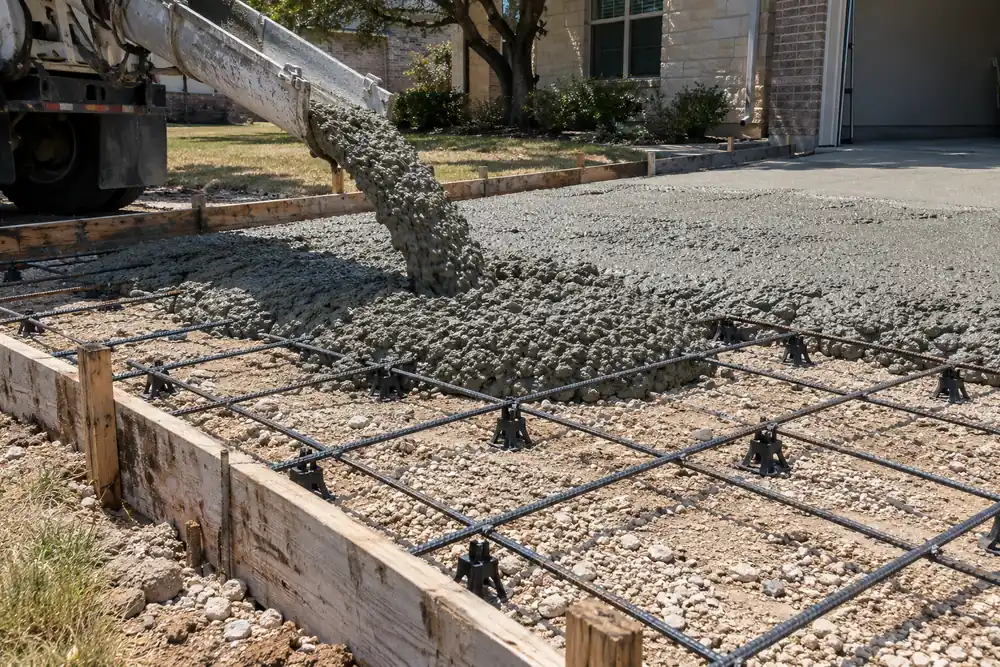
VersaCourt's concrete base recommendations add detail: a medium broom finish; a slope of 0.5% minimum and 1% maximum; control joints tooled into wet concrete or saw-cut within 18 hours; at least 6 inches of subgrade compacted to 98% of maximum density; 6x6 W1.4xW1.4 welded wire fabric at one-third of the slab depth; and #5 continuous rebar around the perimeter with at least 2 inches of cover.
Post-tensioned courts
The ASBA says post-tensioned concrete gives the best overall performance for outdoor play courts. How post-tensioning works is covered on our post-tension slabs page.
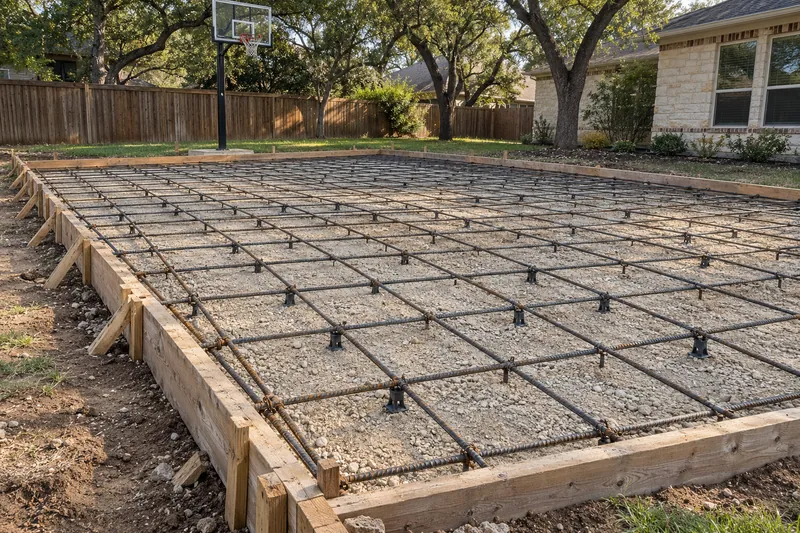
- Control joints tooled or saw-cut within 18 hours (VersaCourt)
- Medium broom finish, sloped 0.5% to 1% (VersaCourt)
- 4 in. minimum, 3,000 psi, 4 in. maximum slump (ASBA)
- Wire fabric at ⅓ of the depth; #5 bar at the perimeter (VersaCourt)
- At least 6 in. of subgrade compacted to 98% (VersaCourt)
Call or request a free estimate any time, 24/7.
(945) 441-5958Courts on Garland clay and in Texas heat
Houston Black clay under a court
In dry periods, the USDA says Houston Black clay cracks ½ to 4 inches wide and 12 inches or more deep. The Dallas County soil survey rates it "Very limited" for concrete driveways and sidewalks, which it defines as reinforced slabs 3 to 6 inches thick, because of high shrink-swell. The soil analysis the ASBA recommends is done by a qualified geotechnical engineer.
Pouring a court in summer heat
Normal highs at DFW Airport are 95.6°F in July and 95.8°F in August (1991-2020 normals). The American Concrete Institute limits concrete to 95°F when it leaves the truck, and the National Ready Mixed Concrete Association advises avoiding the hottest part of the day and curing for at least 3 days.
Call or request a free estimate any time, 24/7.
(945) 441-5958Basketball court cost
In 2026 figures, homeowners spend $12,400 to $60,000 on a basketball court, with an average of $39,400 for a standard full-size court. The 2023 backyard figures in the price box include an asphalt or concrete base, a painted surface and one hoop in the half-court price.
These are national averages, not prices from Garland Elite Concrete. Your estimate is free and based on your yard.
- Half-court, 30 × 30 ft
- $3,600–$14,400
- Full court, NBA 94 × 50 ft
- $18,800–$75,200
- Concrete slab surface, per sq ft
- $5–$10
National averages for backyard courts, 2023. Not a quote.
Call or request a free estimate any time, 24/7.
(945) 441-5958Basketball court questions
How much would a concrete basketball court cost?
A concrete court runs $4 to $20 per square foot, and the concrete base alone, 4 inches thick on ½-inch rebar, $4 to $10 per square foot installed or $18,800 to $47,000 for a full-sized court. Those are national figures from 2022.
Do I need a permit to put a basketball court in my backyard?
The City of Garland's pages list no separate permit rule for a court or slab on private property, so call Building Inspection at 972-205-2300 before you start. Nationally, permit fees for a court run $100 to $1,000, depending on location and project scope. City approval doesn't replace any HOA approval.
How much does it cost to lay concrete for a half-court basketball court?
A 30x30 half-court typically runs $3,600 to $14,000. Estimates that include the base, a painted surface and one hoop put the same size at $3,600 to $14,400, with the concrete slab surface alone at $5 to $10 per square foot. All are national figures.
How thick does concrete need to be for a basketball court?
At least 4 inches, or 5 inches where it will see repeated freeze-thaw cycles, under the American Sports Builders Association's guidelines. VersaCourt's base spec also sets a 4-inch minimum, and national cost figures assume a 4-inch base on ½-inch rebar.
Which direction should an outdoor basketball court face?
North-south. The American Sports Builders Association recommends a north-south orientation as the best compromise between the extremes of early-morning and late-afternoon sun angles.
Free estimates for backyard basketball courts
Garland Elite Concrete answers calls and estimate requests 24/7 for basketball courts and sport slabs in Garland and nearby towns. Tell us the court size you have in mind and what's in the yard now.