Concrete Steps and Porches in Garland, TX
Garland Elite Concrete builds and replaces concrete steps and porches in Garland, Texas: front-door steps and stoops, porch slabs, and steps down to a patio or yard. Garland has used the 2015 International Residential Code since September 19, 2016, and its stair rules set how tall each riser and how deep each tread can be.
Call or send the form for a free estimate. We'll talk through the number of steps, the landing at the door, railings and the finish.
Call or request a free estimate any time, 24/7
No charge · answered 24/7
Get free estimates
Step and stair sizes under the building code
Risers and treads
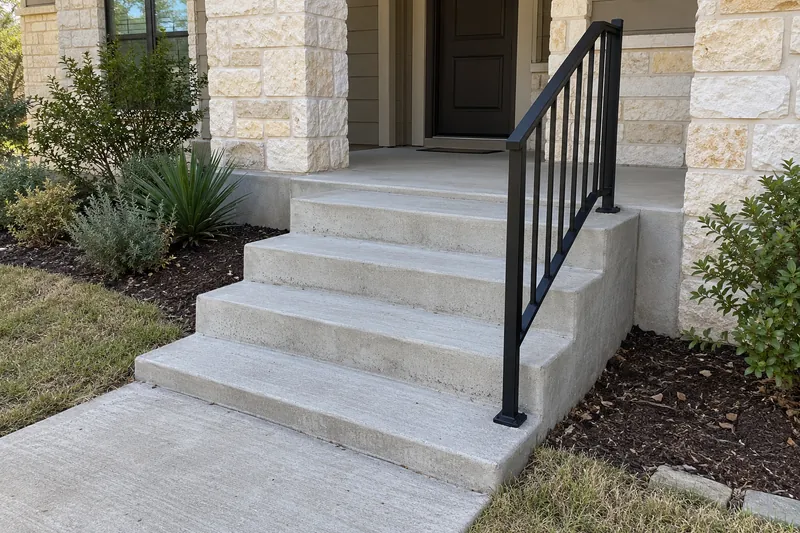
Under the IRC Garland uses, a stair riser may be no more than 7¾ inches and a tread no less than 10 inches deep, and within one flight the tallest riser or deepest tread may exceed the smallest by no more than ⅜ inch. The U.S. Department of Housing and Urban Development's home-safety guide recommends keeping that variation under 3/16 inch, and Cornell University research found that treads narrower than 9 inches cause the most tripping accidents.
Width, landings and slope
Stairways must be at least 36 inches wide, and treads and landings may slope no more than 2 percent. Every exterior door needs a landing at least as wide as the door and at least 36 inches deep; at the required exit door, the outside landing may sit up to 7¾ inches below the threshold if the door doesn't swing over it.
Handrails and guards
A flight with four or more risers needs a handrail on at least one side, 34 to 38 inches above the tread nosings. Porches, stairs and landings more than 30 inches above the ground below need guards at least 36 inches high.
Steps at businesses
Stairs in public and commercial buildings fall under the 2010 ADA Standards, which call for uniform risers of 4 to 7 inches and treads at least 11 inches deep.
Call or request a free estimate any time, 24/7.
(945) 441-5958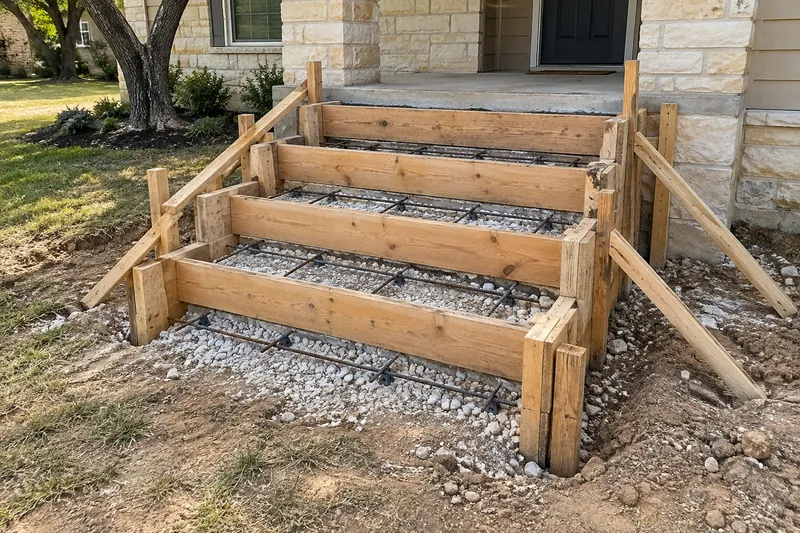
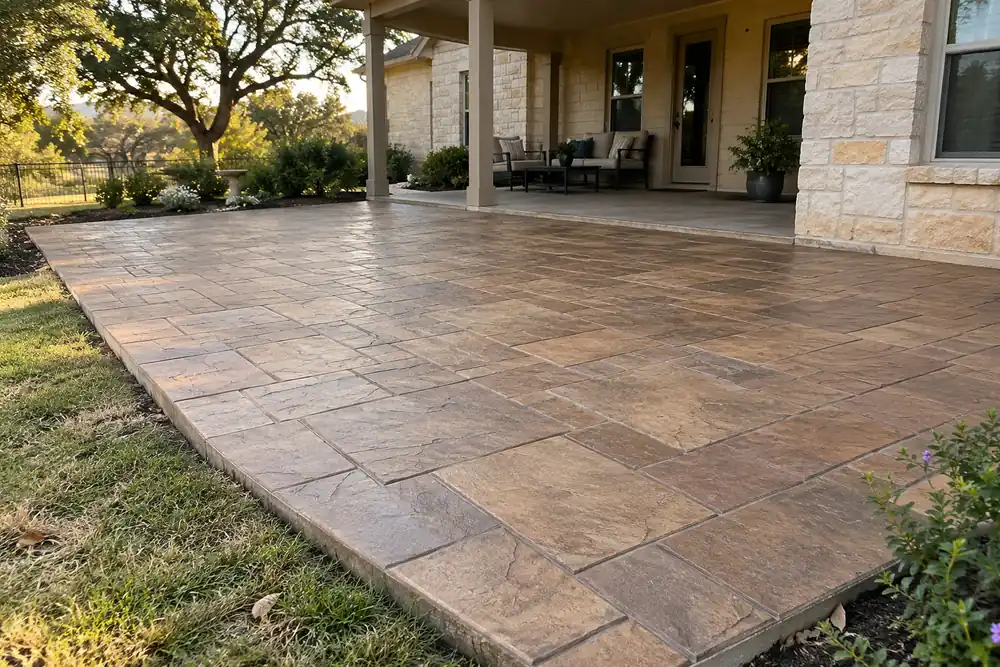
Concrete porches and porch slabs
Edges that hold up
Step edges may chip and spall if the concrete is weak or isn't allowed to cure properly, which is why steps call for a mix with a low water-cement ratio and adequate air entrainment. The National Ready Mixed Concrete Association (NRMCA) says curing should start right after finishing and normally continue 3 to 7 days.
Grip underfoot
NRMCA calls for a broom texture on exterior flatwork for a non-slip surface, and textured finishes or an anti-slip grit added to the protective sealer coat also help.
Slope and joints
The U.S. Department of Energy's Building America guide says porch slabs, patios and walks within 10 feet of the foundation should slope away from it at a 2% grade. NRMCA uses isolation joints to separate driveways and patios from sidewalks, garage slabs, stairs and other fixed points, so each part can move on its own. For the slab at the foot of the steps, see our concrete patios and concrete sidewalks pages.
Call or request a free estimate any time, 24/7.
(945) 441-5958Clay soil, permits and grade changes
Garland's clay
Houston Black clay, the most common soil mapped inside Garland's city limits, shrinks and swells with moisture; the USDA's description records dry-period cracks ½ to 4 inches wide at 12 inches deep. The defense against expansive clay is good compaction first, then drainage, and poor subgrade preparation is one of the most common reasons home slabs fail early.
Permits and HOA approval
A patio or porch cover, attached or freestanding, needs a City of Garland building permit. The City's permit pages cover driveways, approaches, public sidewalks, patio covers, retaining walls and foundation repair, so for steps or a porch slab, call Building Inspection at 972-205-2300 before work starts. Depending on size and local codes, a building permit for steps may be required. City approval doesn't replace any HOA approval.
Steps on a slope
Where steps climb a grade, the soil beside them may need a wall. Under the 2015 IRC, retaining walls not braced at the top that hold back more than 48 inches of unbalanced fill must be designed to accepted engineering practice, and Garland requires a permit for a retaining wall any part of which is 4 feet or taller, or that holds a surcharge. Our concrete retaining walls page has more.
Call or request a free estimate any time, 24/7.
(945) 441-5958Concrete steps cost in the Dallas area
In 2026 Dallas figures, concrete steps average $3,609, with most projects between $619 and $5,155. Railings run $310 to $620, a concrete sealer $205 to $410, and removing old concrete stairs $205 to $410, or $2 to $6 per square foot.
These are area averages, not prices from Garland Elite Concrete. The estimate is free.
- 3 ft wide
- $155–$465
- 4 ft wide
- $205–$620
- 5 ft wide
- $260–$775
- 6 ft wide
- $310–$930
Dallas-area averages for 2026, not a quote.
Call or request a free estimate any time, 24/7.
(945) 441-5958Steps and porch questions homeowners ask
What is the average cost to install concrete steps?
In 2026 national figures, poured concrete steps, installed, run $200 to $500 for 1 step, $600 to $1,500 for 3, $1,000 to $2,500 for 5 and $2,000 to $5,000 for 10, including a landing platform when necessary. Stair railings add $20 to $250 per linear foot.
Can you buy concrete steps already made?
Yes. Precast steps run $100 to $350 per step, or $500 to $3,500 in total installed, against $200 to $500 per step for poured steps (national figures). Precast or poured, steps at a home still have to meet the IRC's riser, tread and handrail rules.
What type of concrete is best for a porch?
The IRC sets minimum 28-day strengths for porches and steps exposed to the weather at 2,500, 3,000 or 3,500 psi, depending on the weathering class, and the North Central Texas Council of Governments' recommended amendments place the region in the "Moderate" class. For exterior slabs, NRMCA's guidance on scaling calls for 4,000 psi concrete, consistent with ACI 332, or 3,500 psi where the concrete won't stay continuously moist and deicing chemicals won't be used. Local amendments can change code tables, so confirm with Building Inspection.
How much does it cost to repair a concrete porch?
In 2026 figures, porch repair averages $300 to $2,500: $300 to $800 to patch or seal small cracks, $800 to $2,000+ to resurface, $300 to $2,500+ to level a sinking or uneven porch, and $1,000 to $2,500+ to fix large cracks or crumbling concrete. Most contractors charge minimum job fees of $300 to $700 or more, and cracks wider than 1/4 inch indicate potential structural issues.
What are some creative ways to resurface a concrete porch?
Two good options are a stamped overlay, applied 1/4 to 3/4 inch thick, which properly applied should last 10–20 years or more, and acid stain, which is translucent and leaves no film. A thin resurfacer such as QUIKRETE Re-Cap goes on from a feather edge of 1/16 inch up to 1/2 inch. Resurfacing may not be viable over large cracks, significant spalling or severe settlement. Resurfacing steps runs $150 to $500 in 2026 figures, depending on the damage.
Free estimates for concrete steps and porches
Garland Elite Concrete answers calls and estimate requests 24/7 for new and replacement steps, stoops and porch slabs in Garland and nearby towns. Tell us how many steps you have and what's there now.