Concrete Retaining Walls in Garland, TX
Garland Elite Concrete builds poured concrete retaining walls in Garland, Texas, for sloped yards, garden beds and level ground beside patios, steps and driveways. The City requires a permit for any wall that reaches four feet or holds a surcharge, such as vehicles or added soil, and a wall holding a surcharge also needs an engineer's report.
Call or send the form for a free estimate. We'll talk through the wall's height, what will sit above it, drainage behind it and the City's permit.
Call or request a free estimate any time, 24/7
No charge · answered 24/7
Get free estimates
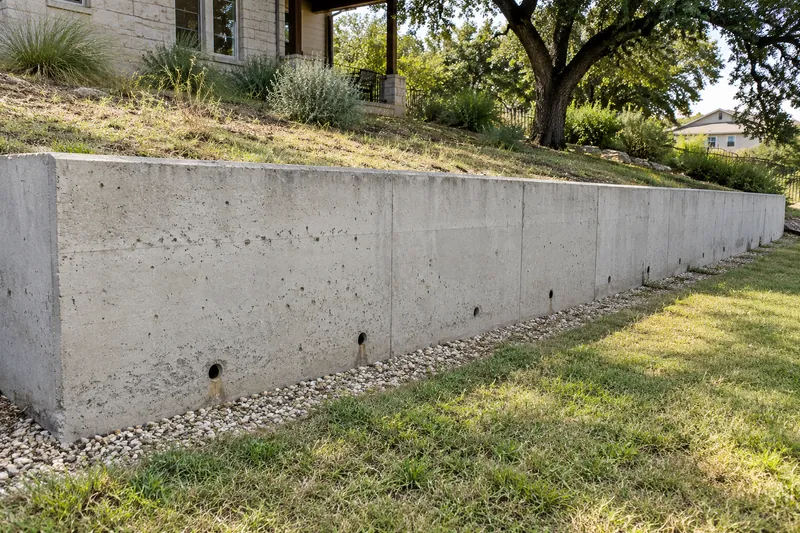
How a poured concrete retaining wall is built
These steps follow common practice, the National Ready Mixed Concrete Association (NRMCA) and the City of Garland's construction notes. A real wall's design depends on its height, soil and loads.
Mark the utilities
Garland's construction notes require contractors to call Texas811 and not begin work until all utilities have been marked on the ground.
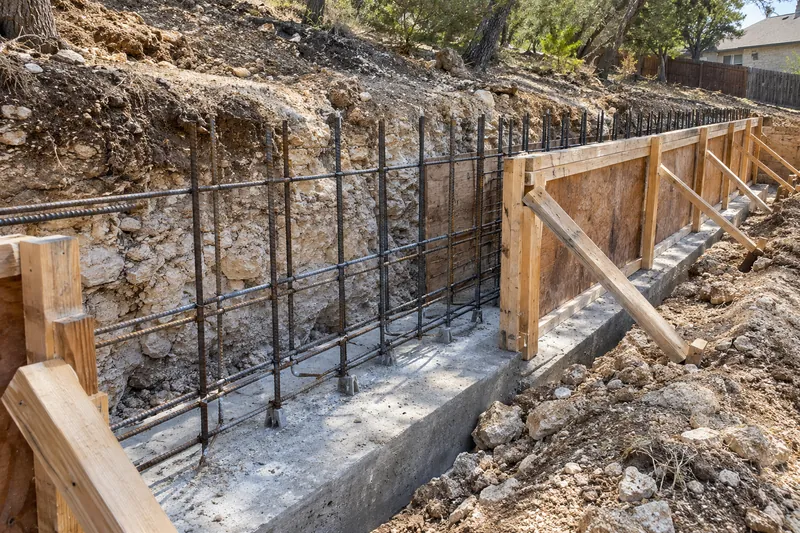
Dig for the base slab
The bottom of the base slab should be at least two feet deep, and the base slab is usually about 50% to 70% as long as the wall is tall.
Pour the footing
If the wall will be taller than four feet, the footing should be poured separately.
Cure the concrete
The NRMCA says curing should start right after finishing and continue 3 to 7 days; concrete left to dry out can lose as much as 50 percent of its potential strength.
Drain the back of the wall
Drainage lines are often perforated pipe wrapped in geotextile or buried in a granular filter bed.
Call or request a free estimate any time, 24/7.
(945) 441-5958Retaining wall height rules and Garland permits
What the 2015 IRC requires
Garland uses the 2015 International Residential Code. Under its Section R404.4, a retaining wall that isn't laterally supported at the top and holds back more than 48 inches of unbalanced fill, or a wall over 24 inches tall that resists lateral loads in addition to soil, must be designed in accordance with accepted engineering practice. The International Code Council notes that the 2015 edition raised the first of those triggers from 24 inches to 48.
The City's permit
If any part of a retaining wall reaches or exceeds four feet in height, or the wall holds a surcharge, Garland requires a permit. It is issued as a fence permit and costs $88 ($70 plus an $18 processing fee). City approval doesn't replace any HOA approval, and rules change, so confirm them with the Building Inspection department (972-205-2300) before work starts.
Call or request a free estimate any time, 24/7.
(945) 441-5958Clay soil, slopes and rain in Garland
Shrink-swell clay
Houston Black clay is the most common soil mapped inside Garland's city limits. The USDA describes its high shrink-swell potential, with dry-season cracks ½ to 4 inches wide reaching 12 inches or more, and says water enters it rapidly when it is dry and cracked and very slowly when it is moist.
Sloped ground
The USDA soil survey for Dallas County also maps Ferris and Heiden soils in Garland on 5 to 12 percent slopes, and almost all of the city's mapped soils are clays or silty clays.
Spring and fall rain
At DFW Airport, May is the wettest month at 4.78 inches and October the next at 4.37 inches (1991-2020 normals). The National Weather Service says rain here tends to come in a wet spring and fall with a dry summer and winter.
Outside the city, Garland Elite Concrete also builds concrete retaining walls in Rockwall.
Call or request a free estimate any time, 24/7.
(945) 441-5958Retaining walls with steps, curbing and patios
Steps between levels
Where a wall splits a yard into two levels, concrete steps join them. Under the IRC Garland uses, risers may be no more than 7¾ inches and treads at least 10 inches deep, and any flight with four or more risers needs a handrail on at least one side, 34 to 38 inches above the tread nosings.
Low borders for beds
For a border around a bed rather than a wall, concrete curbing is made from a dry mix extruded by machine into a continuous border that can follow any curve. Most curbing jobs take one day.
Level ground for a patio
A wall can make room for a concrete patio on sloping ground. In 2026 Dallas-area prices, leveling or regrading a hilly site ran $1,000 to $3,300. Next to the house, the 2015 IRC still requires the ground to fall at least 6 inches within the first 10 feet.
Call or request a free estimate any time, 24/7.
(945) 441-5958Concrete retaining wall cost
In 2026 Dallas-area figures, concrete retaining walls ran $33 to $55 per square foot, $44 on average, with rebar around $0.90 to $1.75 per square foot. Nationally, a poured concrete wall 3 to 6 feet tall typically costs $60 to $270 per linear foot. Getting sealed engineering plans adds two to three weeks to the timeline.
These are published averages, not prices from Garland Elite Concrete. Your estimate is free and starts with a look at the slope.
- 2 ft tall, per linear ft
- $45–$220
- Up to 6 ft tall, per linear ft
- about $395
- Concrete, per sq ft
- $33–$55
- Rebar, per sq ft
- $0.90–$1.75
Dallas-area averages, 2026. Not a quote.
Call or request a free estimate any time, 24/7.
(945) 441-5958Retaining wall questions
What is the average cost of installing a retaining wall in Texas?
The closest Texas figures are for Dallas, where most retaining wall projects average $6,112, ranging from $3,343 to $9,001. Nationally, a 50-foot concrete wall 3 to 6 feet tall averages $6,500, typically $3,000 to $10,000.
What goes behind a retaining wall?
Granular backfill is the usual choice because it drains well, compacts easily and adds sliding resistance. For large walls, 4-inch weep holes are common.
What counts as a surcharge on a retaining wall?
Garland's retaining wall page describes a surcharge as an extra load such as a building, vehicles or added soil. The International Code Council's examples of the added loads that trigger engineering on walls over 24 inches are vehicles parked above the wall and fences built on top of it that are subject to wind loads.
When does a retaining wall need an engineer?
When it passes the 2015 IRC triggers above, and in Garland whenever it holds a surcharge, since the City then asks for an engineer's report. The International Code Council says engineered walls are designed for stability against overturning, sliding, excessive foundation pressure and water uplift, with a safety factor of 1.5 against sliding and overturning. As a rule, a wall more than 4 feet tall, or one with special concerns about the weight being held, needs a structural engineer.
Do retaining walls on a slope cost more?
Yes. Retaining walls on slopes can cost up to 3 times more than on level ground because of deeper footings and extra drainage. Height adds cost too: Dallas-area prices run from $45 to $220 per linear foot for a 2-foot wall to about $395 for walls up to 6 feet.
Free estimates for concrete retaining walls
Garland Elite Concrete answers calls and estimate requests 24/7 for poured concrete retaining walls in Garland and nearby towns. Tell us how tall the slope is and what sits above it.