Curb and Gutter in Garland, TX
Garland Elite Concrete builds concrete curb and gutter in Garland, Texas, for commercial sites, parking lots, driveway approaches and street work in the city right-of-way. Garland's Technical Standards Manual allows mountable curbs on local streets, but requires a standard 6-inch curb at every curb inlet and intersection.
Call or send the plans for a free estimate. We'll price the work against the engineer's details, TxDOT's Item 529 where the plans call for it, and the City's permit rules.
Call or request a free estimate any time, 24/7
No charge · answered 24/7
Get free estimates
Street curbs and driveway curb returns
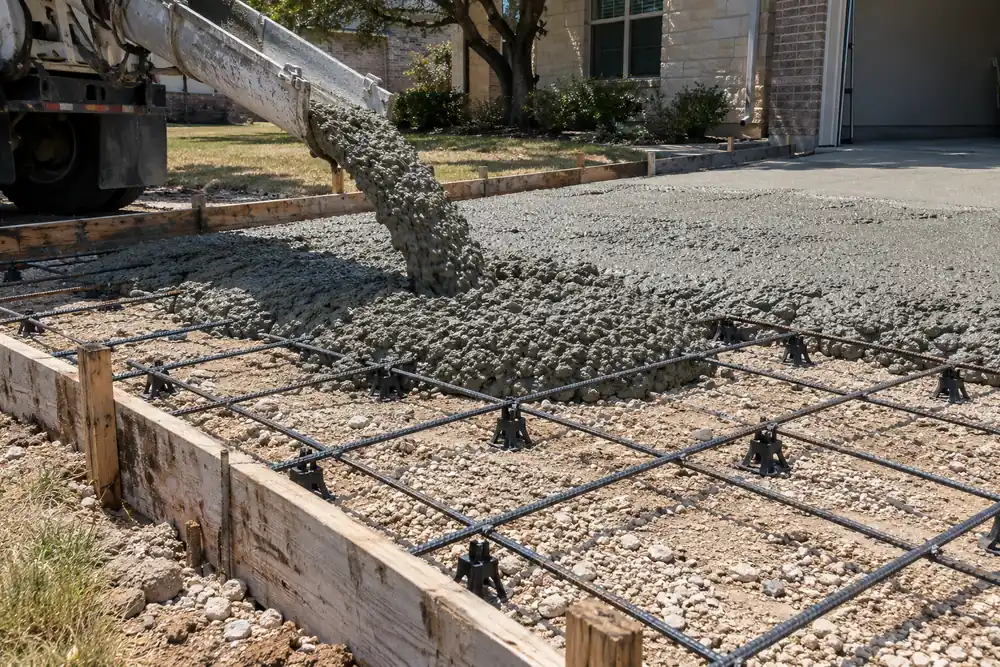
Garland's Technical Standards Manual sets a 40-year design life for city streets, which are paved with 4,000 psi Class P1 concrete per the regional NCTCOG standard and reinforced with #4 bars 18 inches on center.
Street width and parkway grade
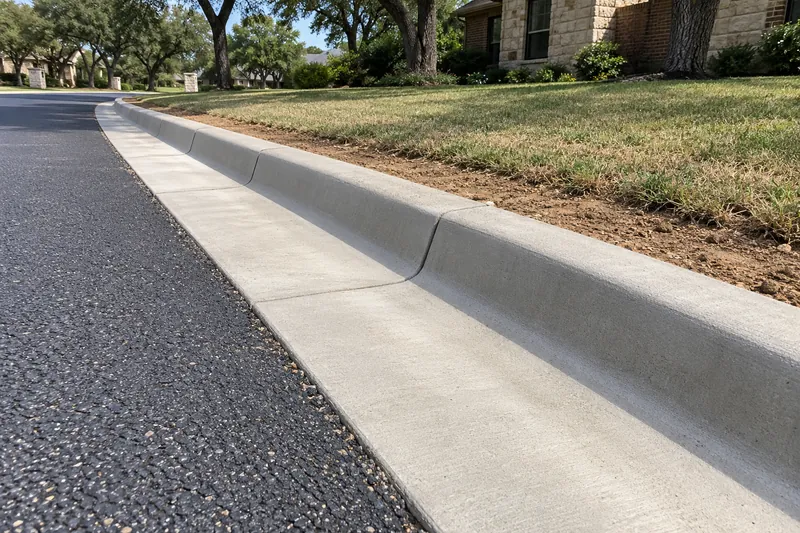
Local streets with mountable curbs are 29 feet wide, measured from back of curb to back of curb. Behind the curb, the manual grades the parkway between the curb and the right-of-way line at 2% above the top of the curb.
Curb returns at driveway approaches
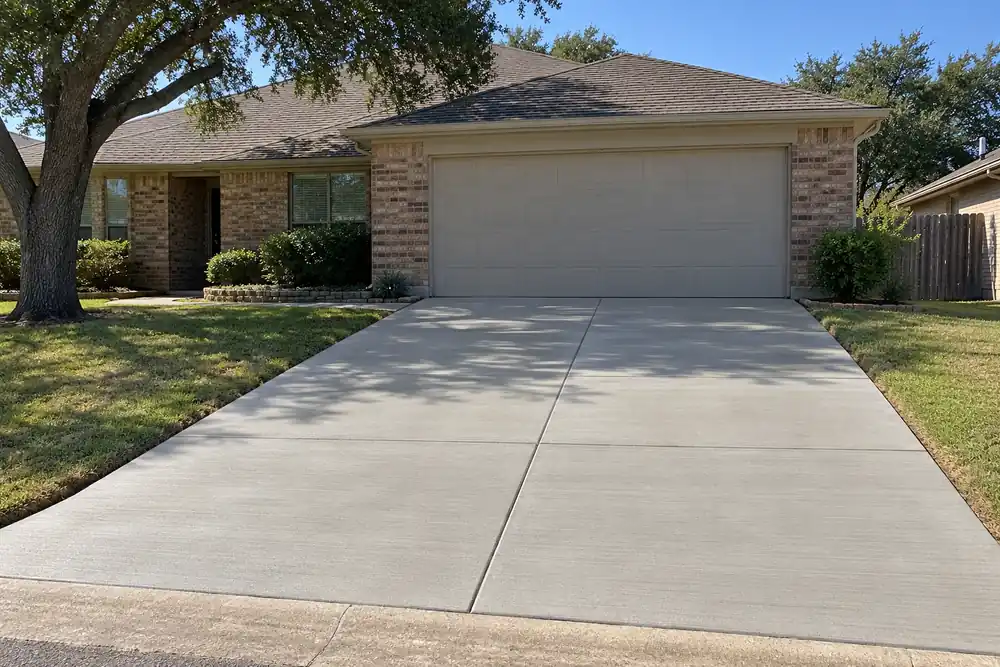
Every Garland driveway approach meets the street at 90 degrees, with a circular curb radius tying the street's 6-inch raised curb into the drive, and the radii must fall entirely within the owner's property. The City's walk-and-approach permit form also requires the radius to start at least 10 feet from an inlet box, and the face of the driveway curb to sit at least 2.5 feet from a fire hydrant. The approach itself is covered on our driveway aprons page.
Call or request a free estimate any time, 24/7.
(945) 441-5958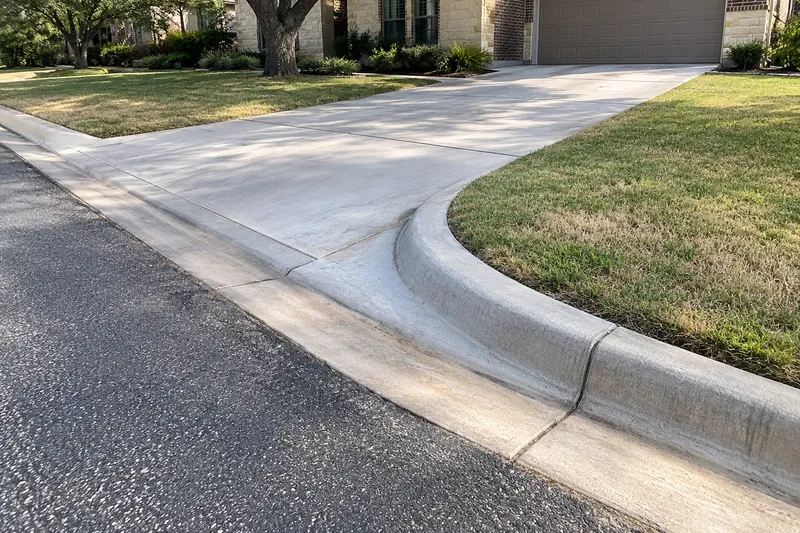
Concrete, joints and curing
Concrete class and strength
TxDOT's Class A concrete, its general-use class for curb, gutter, sidewalks and driveways, has a 3,000 psi design strength, and Item 529 allows fibers to replace the reinforcing steel in Class A concrete unless the plans say otherwise. A draft regional drawing from the North Central Texas Council of Governments (NCTCOG) for commercial driveway approaches specifies Class C, 6-sack concrete of 3,600 psi at 28 days for curbs and gutters. It's still marked draft, so the plans for your job decide.
Joints and curing
TxDOT requires the curb's expansion and contraction joints to match the type and location of the joints in the pavement beside or under it, with expansion joints carried through the curb. In Garland street paving, saw cuts are 1/8 to 1/4 inch wide and one-fourth of the concrete depth, no more than 15 feet apart in 6- to 9-inch pavement and 20 feet in 10- to 11-inch pavement. TxDOT then requires at least 72 hours of curing, and for summer pours the American Concrete Institute limits concrete to 95°F when it's discharged from the truck.
Subgrade on Garland clay
Garland requires at least 8 inches of stabilized subgrade under all pavement sections, treated with lime and cement, lime only or cement only; the City's standard rate is 18 pounds of lime plus 36 pounds of cement per square yard. For new streets and alleys, lab tests measure how much the soil swells, and above 2% a geotechnical engineer must recommend how to bring it to 2% or less. The most common soil mapped inside the city limits is Houston Black clay, which the USDA describes as having high shrink-swell potential.
- Saw cut ¼ of the depth, 1/8 to 1/4 in. wide (City of Garland)
- 4,000 psi Class P1 street paving (City of Garland)
- #4 bars, 18 in. on center (City of Garland)
- 8 in. minimum stabilized subgrade, lime and/or cement (City of Garland)
- Houston Black clay, high shrink-swell (USDA)
Call or request a free estimate any time, 24/7.
(945) 441-5958Permits, inspection and ramps
Right-of-way permits
Garland's code bars anyone from building, repairing, removing or replacing a curb, gutter, driveway or other concrete on public property without the needed permits, including a Right-of-Way Permit and a Sidewalk and Driveway Approach Permit. The approach permit is issued by Building Inspection. The right-of-way work permit comes from the Engineering Department's Field Operations Group, and contractors working in the right-of-way must register with the City.
Before and after the pour
The City's general construction notes say the Engineering Department must be notified 24 hours before construction, and that work won't be accepted without a permit and a city inspection. Contractors must call Texas811 and wait until all utilities are marked on the ground. When the work is done, the permit holder has to remove unused materials, dirt and debris and leave the street and sidewalk clean and usable.
Accessible ramps at corners and driveways
Garland's manual requires barrier-free ADA ramps at all street intersection corners, crosswalks and alley-street intersections, and across any non-residential or multi-family driveway. Under the 2010 ADA Standards, a ramp run can be no steeper than 1:12 and can rise no more than 30 inches. Rules change, so confirm them with the City.
Around the curb line, Garland Elite Concrete also pours the lots, approaches and walks covered on our commercial concrete page.
Call or request a free estimate any time, 24/7.
(945) 441-5958Curb questions from owners and builders
What does curb and gutter mean?
TxDOT's standard specifications treat it as one item of work. Item 529 covers hydraulic cement concrete curb, gutter, and combined curb and gutter, built with Class A concrete (a 3,000 psi design strength) unless the plans specify another material, and the finished work is measured and paid by the foot.
What is the purpose of a curb?
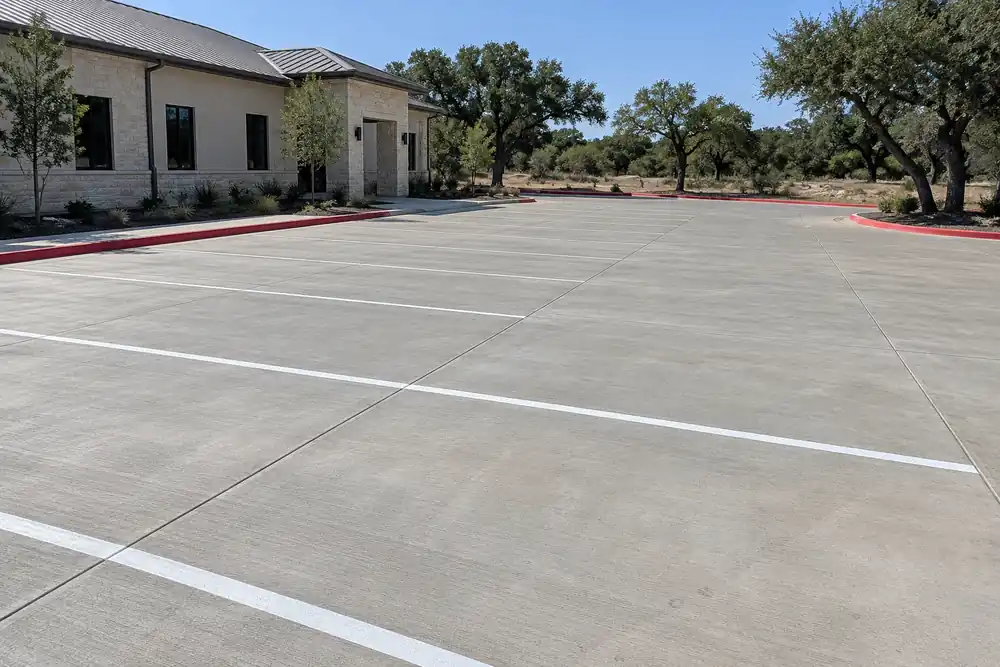
On a parking lot, Garland requires a raised curb of at least 6 inches, or a similar device, to keep vehicles out of islands, sidewalks and other areas that aren't for vehicles. The National Ready Mixed Concrete Association (NRMCA) adds a second job: it recommends a thickened edge on the outside of slabs that carry wheel loads, and says that edge usually takes the form of an integral curb. Lot layout and joints are on our concrete parking lots page.
How to form a curb and gutter?
TxDOT's Item 529 describes two ways. Hand-formed work is placed in sections of 50 feet at most unless otherwise approved, while extruded or slipformed curb is placed with approved self-propelled equipment. Exposed edges are rounded with an edging tool to the radius shown on the plans, and changes in curb grade and alignment can't exceed 1/4 inch between any two contacts on a 10-foot straightedge.
How much to charge for curb and gutter?
The only published unit prices we found are TxDOT's average low bids, and they date from 2016: $21.55609 per linear foot for concrete curb and gutter (Type II) in TxDOT's Dallas District and $21.37350 statewide, over the twelve months to December 31, 2016. For tear-out, removing a concrete gutter averaged $350 to $500 nationally in 2025 figures. These are dated, published figures, not prices from Garland Elite Concrete; send the plans for a free estimate.
Who pays to fix a damaged curb in Garland?
The owner of the property next to it. The City of Garland's Street Department says it doesn't maintain sidewalks and curbs: under city ordinance (Article X, Section 31.134-138), the abutting property owner must keep the sidewalk, parkway, curb and driveway in good, safe condition. The Street Department also runs a 50/50 cost share program for sidewalk, curb and gutter repair.
Free estimates for curb and gutter work
Garland Elite Concrete answers calls and estimate requests 24/7 for curbs, gutters, driveway curb returns and right-of-way concrete in Garland and nearby towns. Describe the job or send the plans.