Garland Driveway, Approach and Sidewalk Permits
Garland Elite Concrete keeps Garland's concrete permit rules in one place: in Garland, Texas, a new or widened driveway, a driveway approach in the City right-of-way and any repair to the public sidewalk each need a City permit.
Most driveway jobs also touch the driveway apron at the curb, which has its own permit and its own City standard. The rules below come from the City of Garland's Building Inspection and Engineering departments and its Code of Ordinances, as published in September 2026. City rules change, so confirm current requirements with Building Inspection at 972-205-2300 before any concrete is poured.
Call or request a free estimate any time, 24/7
Driveway permits in Garland
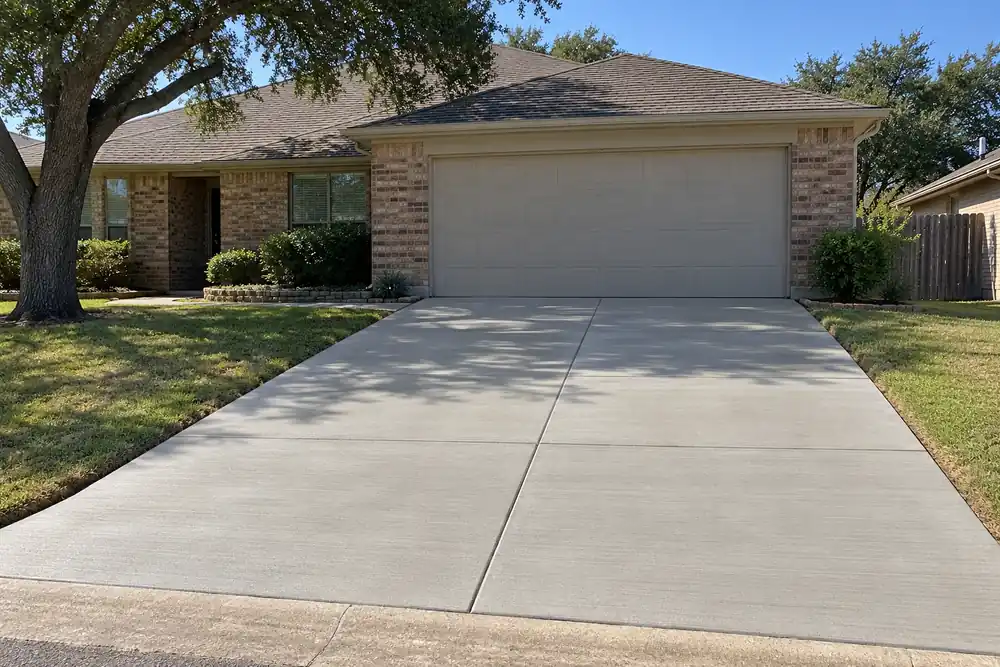
Garland requires a permit to pour a new driveway or widen an existing one. The driveway permit costs $88, which is $70 plus an $18 processing fee, and parking on an unimproved surface is prohibited by City ordinance. Building Inspection lists new driveways among the home projects that often need a permit and asks owners who aren't sure to call before starting work.
What the City requires in the slab
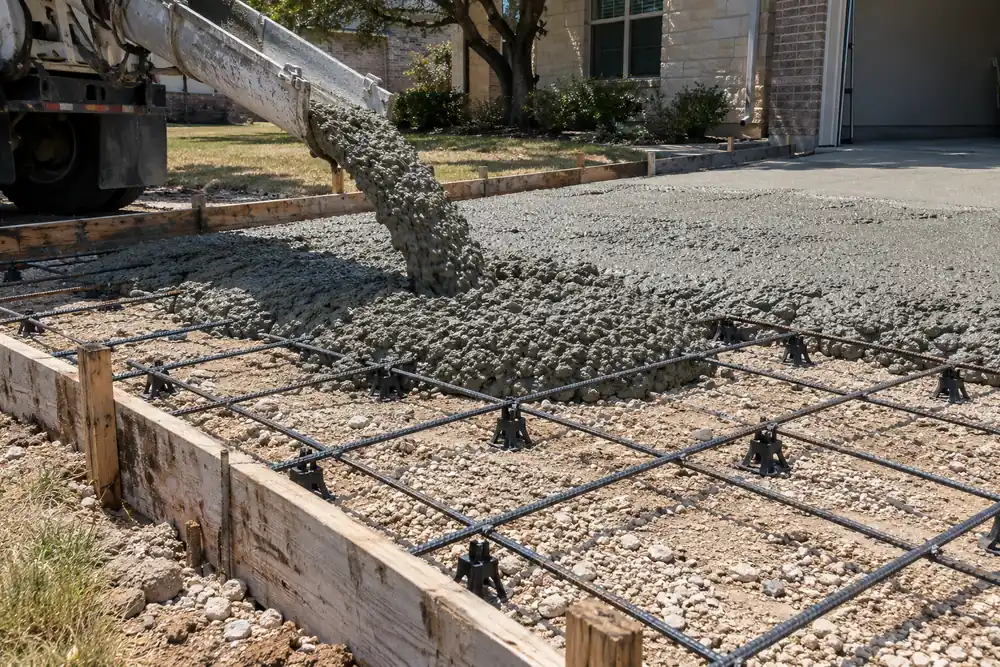
Front- and side-yard driveways must be reinforced concrete or concrete pavers. A concrete driveway must be 4 inches thick with Number 3 rebar placed 18 inches on center on rebar chairs. A paver driveway must use interlocking concrete paving stones at least 2 inches thick, on bedding sand over at least 4 inches of compacted crushed stone, cement-treated base or soil cement base. For homes, Garland has adopted the 2015 International Residential Code, effective September 19, 2016.
Size and placement limits
A driveway may not cover more than 50% of a yard; a circular driveway with two approaches may cover up to 65%. The City's Technical Standards Manual sets single-family driveway widths at the property line at 10 feet minimum and 24 feet maximum to a street, or up to 32 feet to an alley where the garage faces the alley, and allows a circular driveway 10 to 16 feet wide. A home gets at most one driveway onto a public street, unless the Transportation Director approves a circular drive, and no residential driveway may open onto an arterial street classed as a Type A, B or C thoroughfare. City approval doesn't replace any approval your homeowners association requires.
Older homes and gravel parking
Two exceptions help older properties. Homes built on or before January 1, 1980 may keep an original gravel, asphalt or macadam parking surface, as long as it has been properly maintained. Homes built on or before January 1, 1970 without paved alley access may build a limited front-yard parking surface. In both cases the driveway approach at the street must still be concrete.
Planning a new or wider driveway? Call or request a free estimate, 24/7.
(945) 441-5958
Driveway approach permits
The approach is the stretch of driveway in the City right-of-way, between your property line and the street. It needs its own Approach Permit, and approaches are reviewed and approved by the Transportation Department, in the same building as Building Inspection. The approach fee is set by the City; confirm the current amount with Building Inspection when you apply. Garland's code bars anyone from building, repairing, removing or replacing a curb, gutter, driveway or other concrete on public property without the needed permits, including a Right-of-Way Permit and a Sidewalk and Driveway Approach Permit.
The City's standard approach detail
The City's standard drawing for a typical residential approach calls for 5-inch Class "P1" concrete, which the Technical Standards Manual defines as 4,000 psi, reinforced with #4 bars 18 inches apart each way. The approach is at least 10 feet wide and at least 20 feet at the curb, with a 5-foot minimum radius and a ¾-inch full-depth redwood expansion joint at the property line, and no cushion sand is allowed under the pavement. For an approach with a horizontal curb cut, the City requires the existing curb to be cut with a mechanical saw, no hand tools, ½ inch above the existing gutter. Front-entrance approaches need a 5-foot radius and alley approaches a 5-foot flare, and neither may extend past the property lines.
Site plans and clearances
Garland's Walk and Approach Permit form asks for a site plan to enlarge or repair an approach, for a circular drive and for a new approach at an existing home. The radius of a drive approach must start at least 10 feet from a storm inlet, and the driveway curb must sit at least 2.5 feet from a fire hydrant. The same form says the permit holder may use only contractors bonded with the City of Garland. In the right-of-way on a local street, the manual caps a residential driveway's grade at 12%.
Call or request a free estimate any time, 24/7.
(945) 441-5958Sidewalk permits and the sidewalk bond
Any repair to the public sidewalk needs a permit in Garland; the private walk up to your front door does not. A Sidewalk Bond must be on file for whoever does the work. Garland's Code of Ordinances counts driveways and head-in parking as "sidewalk" for these rules, and only the permit holder may do the permitted work. Anyone building or repairing sidewalks must post a $2,000 bond with the City, which obliges them to maintain the work for two years, at no extra cost to the customer, to the satisfaction of the Streets Department, whose decision on sidewalk work is final.
The City's sidewalk standard
For a concrete sidewalk in the right-of-way, Building Inspection's spec is 4 inches of concrete with Number 3 rebar placed 24 inches on center on rebar chairs, kept at least 3 inches from each edge. The City's standard drawing adds the rest: 4 feet wide on residential streets and 6 feet on commercial ones, Class "C" concrete sloped 1% toward the street, ½-inch full-depth redwood expansion joints no more than 24 feet apart, tooled joints at least ½ inch deep, a white-pigmented curing compound to TxDOT's spec, and no more than 2 inches of cushion sand beneath.
When a sidewalk has to be fixed
Homeowners are responsible for the sidewalk, parkway and driveway next to their property. The code treats a sidewalk as hazardous when adjoining sections or the edges of a crack differ in height by 2 inches or more, or a crack has opened a gap of 1½ inches or more, and an owner who gets a repair notice from the Streets Department has 30 days to fix it, with exceptions along certain thoroughfares. The City's standard construction details set a tighter test for existing sidewalks, driveways and gutters: cracks or joints ¾ inch out of line vertically, or ¾ inch apart, mean that section is replaced, and tree roots causing the problem are cut out.
Got a sidewalk notice from the City? Call or request a free estimate, 24/7.
(945) 441-5958Garland's sidewalk cost-share program
When bond money is available, the City of Garland may split the cost of rebuilding a residential sidewalk 50-50 with the owner, and it cuts the owner's share further: an extra 15% with a Dallas County homestead exemption, 15% for addresses in a Community Development Block Grant area, and 10% for owners who are disabled or 65 or older. An owner who qualifies for all three may pay as little as 10% of the cost. The City's own worked examples show a $1,000 sidewalk costing an owner who qualifies for every reduction $100, and a $2,000 sidewalk costing an owner with only a homestead exemption $700.
The program takes time. The City's timeline runs 3 to 5 business days for an inquiry, 2 weeks for assessment and paperwork, and 3 to 6 months for the owner's sign-off and construction, for an overall expectation of 8 to 12 months. The Street Department runs it, at 972-205-2930.
Call or request a free estimate any time, 24/7.
(945) 441-5958Inspections, utility locates and right-of-way work
Garland's general construction notes say the Engineering Department must be told 24 hours before any construction starts, and that work won't be accepted without a permit and a City inspection. Building Inspection is at 800 Main Street, 1st floor, and takes inspection requests on a 24-hour line at 972-205-2300; requests made before midnight are inspected the next business day. Before digging, contractors must call Texas811 and wait until the utilities are marked on the ground.
Work in the right-of-way needs one more permit. Garland's Technical Standards Manual says the sidewalk and driveway approach permit comes from Building Inspection, while a separate right-of-way work permit comes from Engineering's Field Operations Group, and those contractors must register with the City. Registration with the Right-of-Way Management Department costs $400 a year and requires a certificate of insurance naming the City; since January 1, 2025, a General Repair Bond is no longer accepted in place of insurance.
Other concrete jobs that need a permit
A foundation repair needs a permit whenever the repairs cost $2,000 or more; the permit costs $45 ($30 plus a $15 processing fee), and the application needs an engineer's letter. A retaining wall needs a permit, issued as an $88 fence permit, if any part reaches 4 feet or it holds a surcharge such as a building, vehicles or added soil, and a wall holding a surcharge also needs an engineer's report. A patio or porch cover needs a building permit at $0.52 per square foot (minimum $100) plus a 25% processing fee (minimum $25). The City's pages don't list a separate permit for a plain patio slab, so call Building Inspection before you pour one.
Call or request a free estimate any time, 24/7.
(945) 441-5958Permit questions
Do I need a permit to put gravel in my driveway?
Garland's Driveway / Sidewalk page lists only reinforced concrete or concrete pavers as driveway materials for front and side yards, and parking on an unimproved surface is prohibited. The exception is an older home built on or before January 1, 1980, which may keep an original, properly maintained gravel surface. Call Building Inspection at 972-205-2300 before changing a driveway surface.
What are the city ordinances for the City of Garland?
For concrete work, the rules sit in a few places: Chapter 31 of the Code of Ordinances (sidewalks, driveways and concrete on public property), the Garland Development Code adopted May 19, 2015, and the Engineering department's Technical Standards Manual and Standard Construction Details. For homes, Garland has adopted the 2015 International Residential Code.
Does a City permit replace HOA approval?
No. Garland's residential permit application says City approval does not remove the homeowner's duty to get homeowners association approval before construction, where an HOA applies.
Planning a driveway or sidewalk in Garland?
Call or send a request any time, 24/7, for a free estimate, and we'll talk through what the City requires for your job.