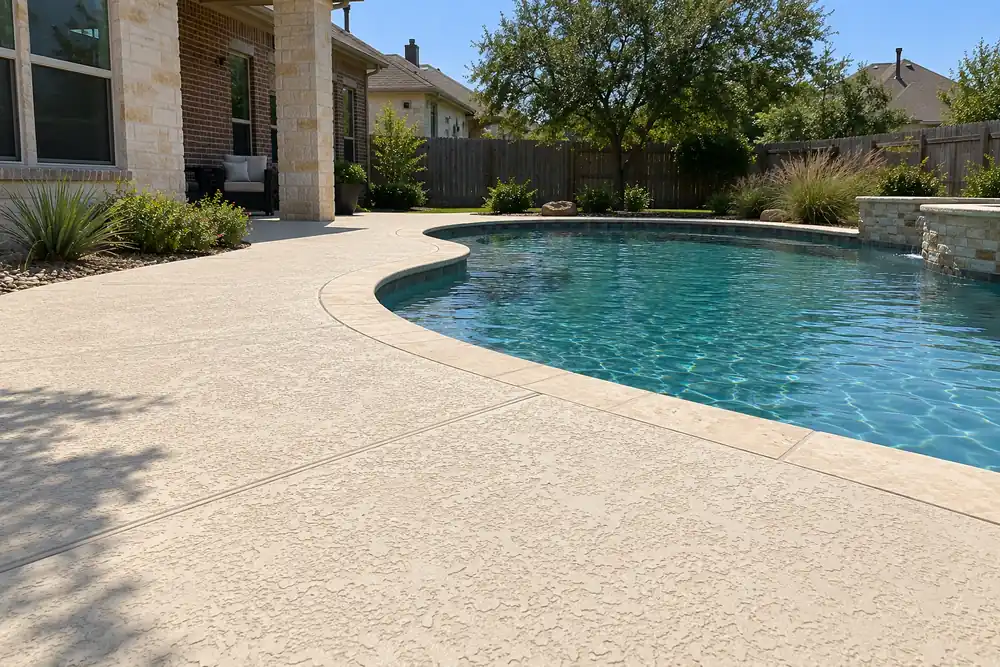
Concrete Slab Foundations in Fate, Texas
Garland Elite Concrete pours residential and commercial slab foundations in Fate, Texas, working from the engineer's plan, which for a new home the City requires to be stamped for that specific lot. Fate grew from 17,958 residents in the 2020 Census to an estimated 29,007 on July 1, 2025, according to the U.S. Census Bureau.
Call or send the form for a free estimate on a slab in Woodcreek, Williamsburg or the Reserve at Chamberlain, along the I-30 corridor, or near Downtown Fate and Robert Smith Family Park on CD Boren Parkway. We'll talk through the engineer's plan, the permit and the pour schedule.
Call or request a free estimate any time, 24/7
No charge · answered 24/7
Get free estimates
New subdivisions, new foundations
The City traces Fate's growth to Dallas expanding east after Lake Ray Hubbard was built in 1971, when Centex homebuilders bought 1,700 acres of raw land that became Woodcreek and the Reserve at Chamberlain. In 2005 alone, 200 homes were built in Woodcreek. The City lists more than seven subdivisions, among them Williamsburg, Spring Meadows, Melody Ranch, Chamberlain Crossing, Sleepy Hollow and Northview Estates, and its municipal utility districts serve about 5,000 existing and entitled homes.
The Census Bureau's 2020-2024 survey estimates put the median year built at 2013, with 1,351 homes built in 2020 or later and about 99% of the housing single-family detached. Williamsburg has its own public improvement districts; Rockwall ISD's Billie Stevenson Elementary is in Woodcreek, and Lupe Garcia Elementary is in Williamsburg. The City's single-family permit packet also asks for at least 70 percent masonry, brick or stone, on new homes, though some subdivision standards differ.
Call or request a free estimate any time, 24/7.
(945) 441-5958Fate's permit path for a slab foundation
Before anyone applies, the lot must be zoned for its intended use and platted as a lot of record. Fate then issues a separate Foundation Permit, which requires drawings and the engineer's inspection report. For a new home, the foundation plan and details must be stamped by a Texas-registered professional engineer, with a letter stating they were designed for that specific lot.
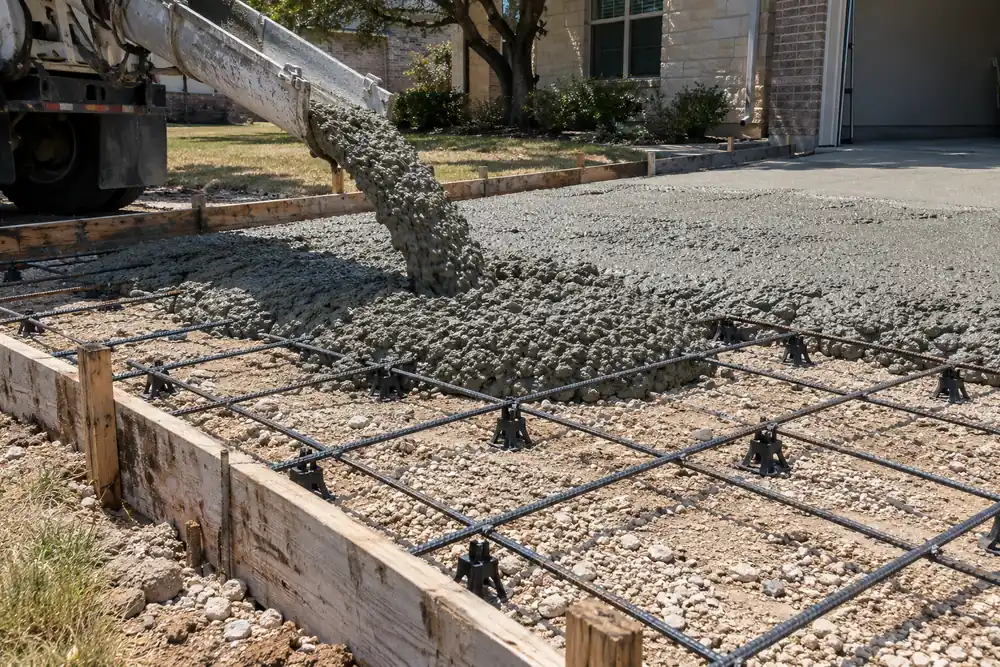
At the foundation inspection, the approved plan has to be on site, and post-tension cables and rebar must be placed as the engineer designed. Where the slab sits on piers, the engineer's inspection report is due at that inspection. A form board survey is required at the plumbing rough-in stage and is uploaded to the City's MyGov portal. Fate's Building Inspections department works from the 2021 International Residential and Building Codes.
Other concrete, other permits
The City's Concrete Permit covers patios, sidewalks and other concrete additions and repairs, and says plainly that it is not for foundations. Driveway approaches go on a Curb Cut and Drive Approach Permit, and retaining walls at or above four feet on a Retaining Wall Permit. Foundation repair has its own rule: the plans must be sealed by a Texas professional engineer, and the engineer of record inspects the repair and reports to the City before its final inspection.
Call or request a free estimate any time, 24/7.
(945) 441-5958Post-tensioned and rebar slabs on shrink-swell clay
The Handbook of Texas describes the soils of Rockwall County, where Fate lies, as loamy to clayey at the surface over clayey subsoils that crack. On Houston Black, the Blackland Prairie clay the Soil Science Society of America calls Texas' unofficial state soil, the society notes that construction is often plagued by cracking from shrinking and swelling, and that building foundations need to be reinforced with steel rods.
Post-tensioned slabs
The Post-Tensioning Institute calls post-tensioned slabs-on-ground a cost-efficient, high-performance answer for home foundations on shrink-swell soils. Compression put into the slab resists the tension that soil movement causes, less concrete and steel are needed for the same capacity, and the slab can often be installed faster than one reinforced with rebar or wire mesh. A residential post-tensioned slab is typically 8 inches thick with 3,000 psi concrete, and tendons 48 inches on center are common.
Code minimums for any slab
The International Residential Code sets 3½ inches as the minimum for a concrete floor on ground, with a separate section for expansive soils. Fill under the slab must be compacted and is limited to 24 inches of clean sand or gravel or 8 inches of earth unless approved, and reinforcement must be held between the center and the upper third of the slab while the concrete is placed. The National Ready Mixed Concrete Association recommends a vapor retarder at least 10 mils thick under interior slabs.
Drilling into a finished slab
Never cut or drill into a post-tensioned slab casually, because a cut tendon is very difficult to repair. Coring one should wait for ground-penetrating radar scanning, and a core within 6 inches of a marked tendon should wait for a structural engineer's review.
- 8 in. slab, 3,000 psi: typical for a home post-tensioned slab
- Tendons 48 in. on center, common for homes
- Compacted fill: at most 24 in. of clean sand or gravel, or 8 in. of earth, unless approved (IRC R506.2.1)
- Clayey subsoil that cracks (Handbook of Texas, Rockwall County)
Call or request a free estimate any time, 24/7.
(945) 441-5958Commercial slabs and special inspections
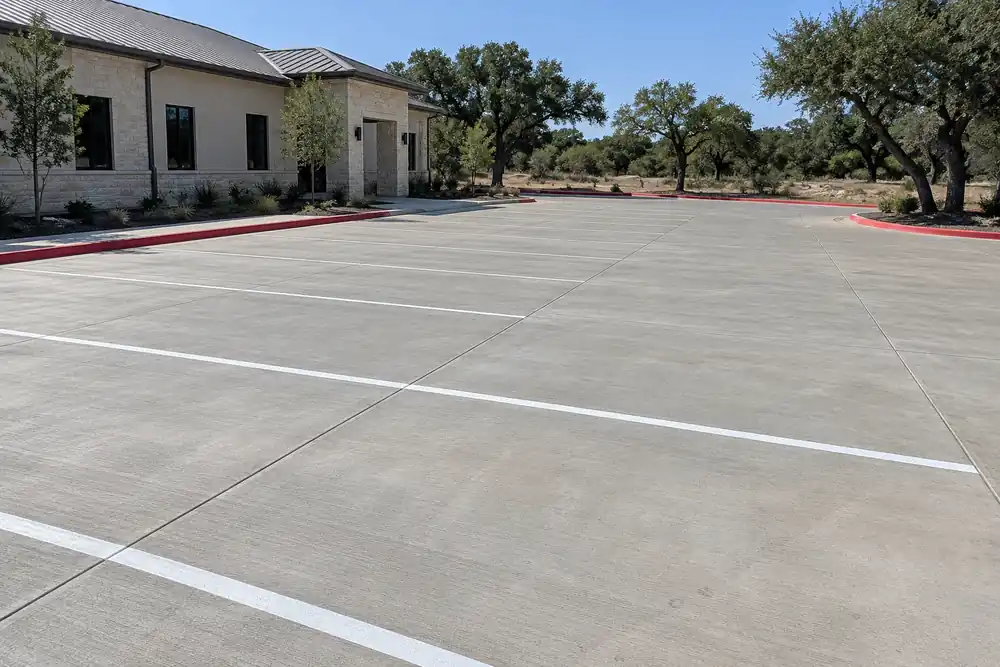
Businesses are beginning to build along Fate's I-30 corridor, where the City names Stags Plaza, Spec's Wine, Spirits and Finer Foods, and FRESH by Brookshire's. Downtown Fate has new mixed-use buildings, including Fate Place and The Hub at Fate Station, a coworking office for small and start-up businesses.
For commercial projects, Fate requires the special inspections listed in Chapter 17 of the International Building Code, covering concrete construction, soils and helical pile foundations, with the owner paying for them. For post-tensioned slabs on expansive soils, the International Building Code (the 2015 edition, as quoted by the Post-Tensioning Institute) calls for design to PTI's standard DC 10.5. We'll talk through the inspection schedule and the engineer's requirements at the estimate.
Call or request a free estimate any time, 24/7.
(945) 441-5958What a slab foundation costs near Dallas
Dallas-area foundations averaged about $7,427 in 2026 figures, with a typical range of $3,134 to $11,714, and soil conditions, site access and foundation type drive most of the difference. The area's Blackland Prairie clay is notorious for its high expandability, so foundations built on it need structural reinforcement and cost more. Nationally, a slab-on-grade house foundation runs $6 to $14 per square foot, and a soil test typically costs $500 to $2,000.
These are typical averages, not prices from Garland Elite Concrete. A real number starts from the engineer's plan, and the estimate is free.
- Concrete slab
- $6,000–$15,000
- Monolithic slab
- $8,000–$18,000
- Stem wall
- $6,000–$18,000
- Pier and beam
- $8,000–$15,000
Typical Dallas-area prices, 2026. Averages, not a quote.
Call or request a free estimate any time, 24/7.
(945) 441-5958Mail routes, a tornado and the old rail line
The town takes its name from "Fate," a nickname. The Handbook of Texas says Lafayette Brown's wife gave it to him; the City says it belonged to either William Lafayette Brown or GW Lafayette Peyton, and no record settles which. The post office opened on July 13, 1880, and on February 11, 1887, the railroad town of Barnes joined the post-office town of Fate and took its name.
On August 1, 1899, Fate became the first town in Texas with a rural mail route. A tornado destroyed much of the town on July 4, 1933, and much of it was never rebuilt. Fate sits on State Highway 66 and the old Missouri, Kansas and Texas rail line, four miles northeast of Rockwall, and Royse City ISD's Worthy Fate High School, off FM 552, is set to open in August 2027.
Call or request a free estimate any time, 24/7.
(945) 441-5958Beyond the foundation
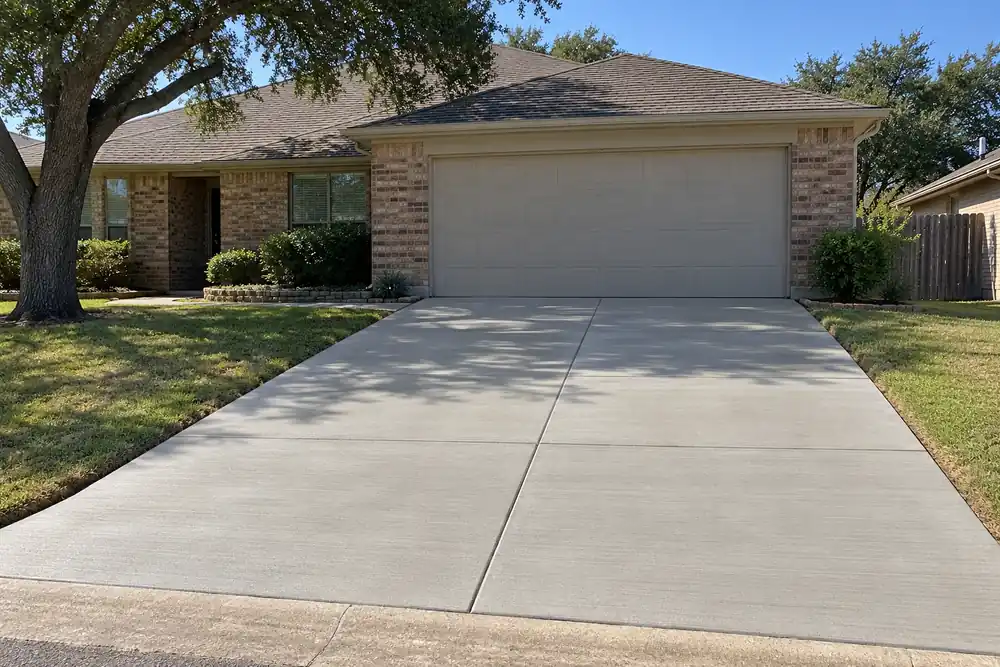
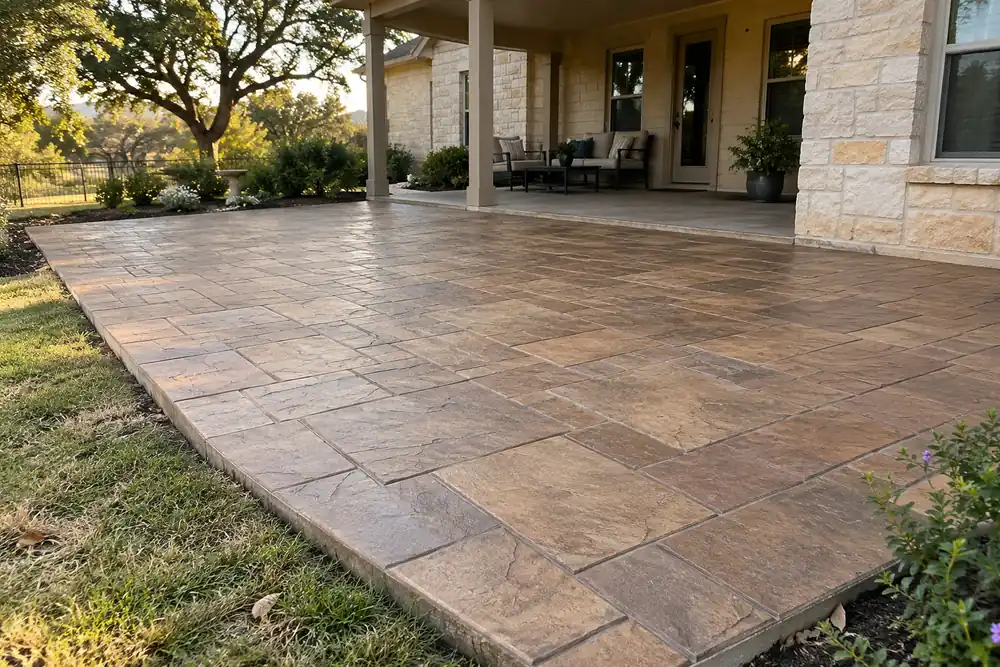
A new house needs more than its slab. We also pour driveways and approaches, patios, sidewalks and retaining walls, each under the City permit that fits the job. Nearby, we build concrete retaining walls in Rockwall and pour concrete pads in Mobile City.
Call or request a free estimate any time, 24/7.
(945) 441-5958From permit to pour
How a slab foundation usually moves through Fate's permit steps, along with general building practice.
Lot, plat and engineer's plan
The lot must be zoned and platted as a lot of record, and the foundation plan arrives stamped by a Texas-registered engineer for that lot. We work up the free estimate from that plan.
Pad, forms and plumbing
The building pad is graded and formed, the under-slab plumbing is roughed in, and the form board survey is uploaded to MyGov.
Steel or tendons
Rebar or post-tension cables are placed as the engineer designed, over a vapor retarder where the slab will be an interior floor.
Foundation inspection
The City inspects with the approved plan on site, and the engineer's report is ready where the design uses piers.
Pour and cure
The concrete is placed and finished, and NRMCA says curing should start right away and typically run 3 to 7 days, with the concrete kept above 50°F.
Stressing the cables
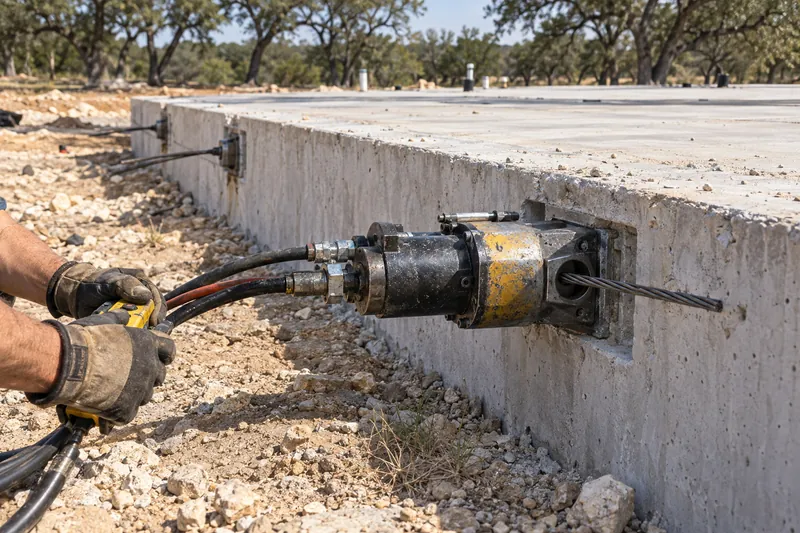
On a post-tensioned slab, each cable is pulled to 33,000 pounds once the concrete reaches 2,000 psi, typically within 3 to 10 days, stretching a 100-foot cable about 8 inches.
Start your slab foundation with a free estimate
Garland Elite Concrete answers calls and estimate requests 24/7 for residential and commercial slab foundations in Fate, from new subdivisions to the I-30 corridor.