Stained and Decorative Concrete in Highland Park, Texas
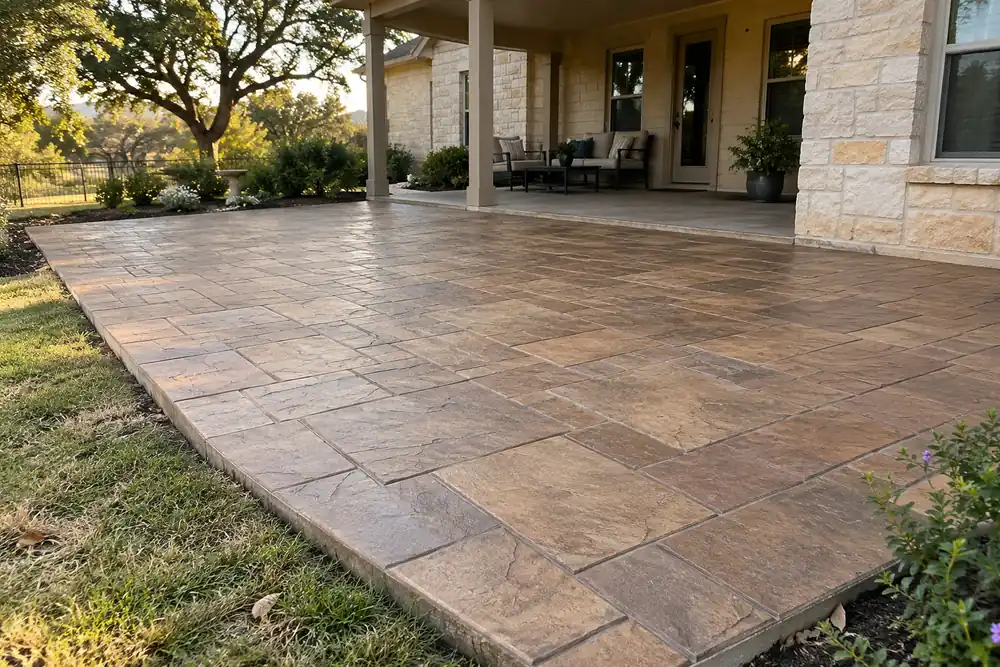
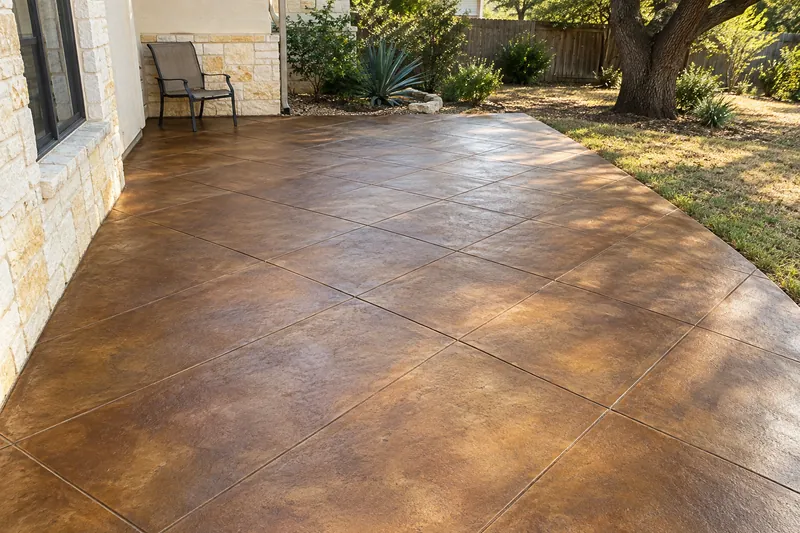
Garland Elite Concrete installs stained and decorative concrete in Highland Park, Texas: acid-stained and water-based stained patios, colored walks, and decorative driveways and approaches built to the Town's paving code. Stain soaks into the surface instead of coating it, so patched or repaired areas take the color differently, and an older slab is checked before a color is chosen.
The Handbook of Texas calls Highland Park a 2.2-square-mile residential "island city", surrounded by Dallas on the south, east and west and by University Park on the north. Highland Park Village, built in 1931 as the first shopping center of its kind in the United States, the Spanish Colonial Town Hall from 1924, the Dallas Country Club and the parks along Turtle Creek anchor the town.
Call or request a free estimate any time, 24/7
No charge · answered 24/7
Get free estimates
Estate lots in a fully built town
Once Dallas annexed the land around it, Highland Park could grow only by building on its few vacant lots or tearing down old buildings, and the Handbook of Texas says it became known for its strict zoning. The Town's zoning ordinance calls it a mature, completely developed community of mostly single-family homes, and the zoning district map in force was adopted on November 3, 1965.
Census Bureau survey estimates for 2020–2024 put the median value of owner-occupied homes at $1,989,900, with about 81% of housing units single-family detached and about 89% of occupied homes lived in by their owners. About half the housing was built before 1980, and the median year built is 1977, which is why the staining notes below spend time on older slabs.
The original sections
John Armstrong bought 1,326 acres in 1906 and chose the name because the land sat on high ground overlooking downtown Dallas. Landscape designer Wilbur David Cook was hired in 1907, and 20% of the original land was set aside for parks. The first two lots sold in 1909, in an area bounded by Armstrong, Abbott and Gillon Avenues and Hackberry Creek, and Highland Park West, built in 1924, was the town's last major land development.
Call or request a free estimate any time, 24/7.
(945) 441-5958The Town's paving code, from permit to finish
Section 3.13.035 of the Code of Ordinances requires a permit from the Building Inspector to build, repair, pave or resurface any walk, drive, curb, gutter or paved area, on public or private property alike, and the application has to come from a bonded contractor registered with the Building Inspector. Flatwork, curb and gutter, fence and pool or spa work each need their own permit and inspections, apart from the house permit.
Anyone building or repairing a sidewalk, curb, gutter or driveway approach must post a $2,000 bond that holds the contractor to maintaining the work for five years. The Town charges $125 to register a concrete contractor and $125 for a bonded concrete contractor (fees effective October 1, 2025), and a permit expires if work doesn't start within six months.
Approach specs
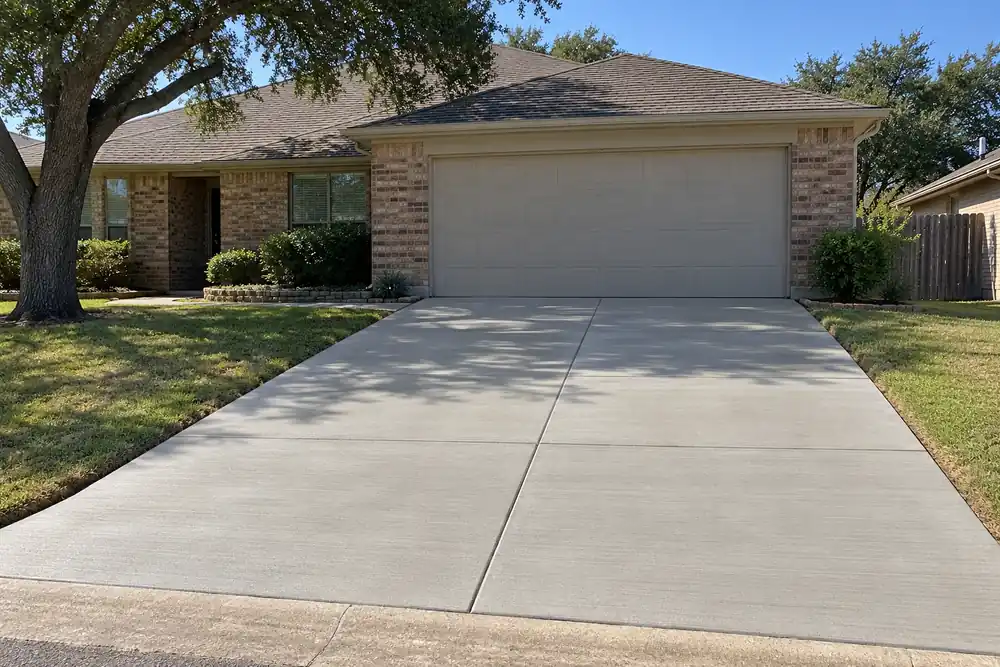
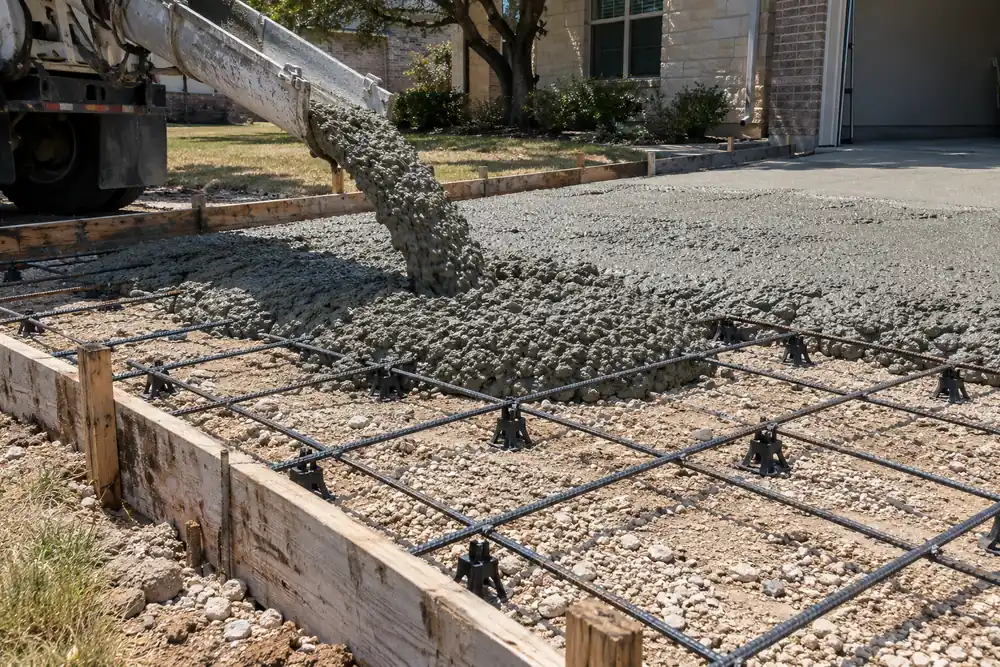
Driveway approaches must be one-course reinforced concrete at least 6 inches thick, with 3,000 psi strength at 28 days and No. 3 bars no more than 24 inches on center both ways, lapped at least 15 inches. The driveway then has to stay free of vehicle traffic for at least six days.
The finish rule
An approach surface may be floated or brushed but may never be left slick or glossy. That shapes decorative work at the street: the American Society of Concrete Contractors (ASCC) notes that the higher a sealer's gloss, the more it enriches color, but on the approach the texture rule comes first.
- Floated or brushed, never slick or glossy (Town of Highland Park)
- 6 in. one-course reinforced, 3,000 psi at 28 days (Town of Highland Park)
- No. 3 bars at 24 in. max both ways, 15 in. laps (Town of Highland Park)
Call or request a free estimate any time, 24/7.
(945) 441-5958Acid stain, water-based stain and integral color
Acid stain
Most acid stains are a mix of water, hydrochloric acid and acid-soluble metallic salts that react with the hydrated lime in the concrete, which keeps their palette to tans, browns, terra cottas and soft blue-greens. The stain is neutralized with water and baking soda, TSP or ammonia and then rinsed thoroughly, and Brickform's data sheet warns that residue left behind leads to sealer adhesion problems.
Water-based stain
Water-based stains, typically acrylic polymers with pigments, don't depend on a chemical reaction, so their color is more consistent. They come in dozens of standard colors, including black, white and metallic tints, need no neutralizing and are mostly low in VOCs.
Integral color for new slabs
On a new pour, pigment can go into the mix instead. The ASTM standard for concrete pigments caps the dosage at 10 percent by weight of cement, most high-quality pigments reach full color at about 5 or 6 pounds per sack, and colored concrete is still subject to mottling and color variation.
Staining an older slab
Stain is translucent, so it hides nothing: Brickform says its acid stain won't cover discoloration, blemishes or cracks. Stain also washes away if the surface pores aren't opened first. Power-troweled or very dense concrete may need mechanical or chemical profiling before it takes acid stain well, according to Brickform.
Call or request a free estimate any time, 24/7.
(945) 441-5958Heat, sealers and timing
Brickform says to apply its acid stain when the air is between 50°F and 90°F, and the ASCC sealer guide says water-based sealers go on when air and concrete are 45°F and rising but not above 90°F. Normal daily highs at DFW Airport reach 95.6°F in July and 95.8°F in August (1991-2020 normals), which puts a typical midsummer afternoon outside both windows.
On a sunny, warm day an exterior stain job may be ready for sealer in a couple of hours. Once it is sealed, Brickform says to keep foot traffic off for 24 hours and vehicles off for 5 days.
Decorative sealers wear away as a sacrificial coat. The ASCC's rule of thumb is new sealer every 2-3 years on high-traffic and sun-exposed areas and every 4-5 years on lighter-traffic and interior ones. For stained concrete specifically, a reseal every 1 to 3 years is the common advice.
Call or request a free estimate any time, 24/7.
(945) 441-5958Pool decks, front yards and other decorative work
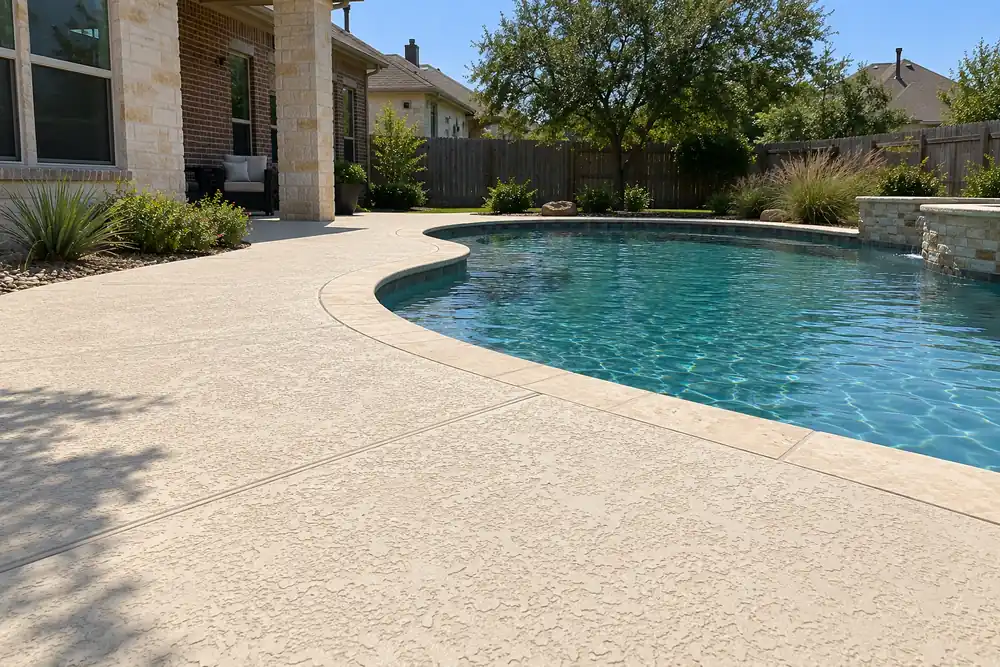
Stain is one of several finishes we handle, along with stamped patterns, exposed aggregate, overlays and resurfacing, and pool decks.
Pool work runs on its own permit here. The Town's pool permit packet asks for a deck layout and requires a deck steel inspection, with a fee of 1.1% of construction cost and a $55 minimum. In the required front yard, a masonry or concrete retaining wall is allowed only if it's no higher than the ground it holds back, and total paving, including driveways, walks and porches, may not exceed 50% of the front yard. Construction is allowed Monday through Saturday, 7 a.m. to 6 p.m.
For neighbors to the north, Garland Elite Concrete also pours stamped patios in University Park, and it handles industrial concrete in Farmers Branch as well.
Call or request a free estimate any time, 24/7.
(945) 441-5958How a stain job runs
General practice and Brickform's acid stain data sheet; your estimate covers your slab.
Check the slab
A new slab needs time first: 10 days to 2 weeks of curing is typically enough before staining, especially in warm, dry weather. On an older slab, patches and dense troweled areas are noted, since they take stain differently.
Clean and open the surface
The surface is cleaned and its pores opened, because stain washes away if the pores aren't opened first.
Apply the stain
Brickform's acid stain reacts with the free lime at the surface for a permanent color change and covers about 200 to 300 square feet per gallon.
Neutralize and rinse
Acid stain is neutralized to stop the reaction, then rinsed until no residue is left for the sealer to fight.
Seal the surface
Exterior stained concrete is protected with a clear sealer, and on properly prepared concrete the color won't fade, chip or peel.
Call or request a free estimate any time, 24/7.
(945) 441-5958Questions about the Town's rules
Do I need a permit to stain an existing driveway or patio in Highland Park?
The code requires a Building Inspector's permit to build, repair, pave or resurface any walk, drive, curb, gutter or paved area, on public or private property. Staining isn't named on its own, so ask the Building Inspector whether a stain-and-seal job on an existing slab counts before work begins.
How wide can a driveway be in Highland Park?
Residential driveway approaches must be 9 to 20 feet wide at the property line, and a lot may have no more than two approaches into its front and side yards. Front- and side-yard driveways may be straight, curved or semicircular, 9 to 20 feet wide, and need an all-weather surfaced area of at least 180 square feet on the property. Commercial approaches run 12 to 40 feet wide.
Can a decorative material other than plain concrete be used?
Section 3.13.046 lets the Building Inspector approve alternate materials or methods when they are shown to be sufficient, safe and equal to the code's standards, so raise any non-standard material or finish with the Building Inspector when applying for the permit.
Free estimates for stained and decorative concrete in Highland Park
Garland Elite Concrete answers calls and estimate requests 24/7 for stained patios, colored walks and decorative driveways. Tell us what the slab looks like now and the color you have in mind.