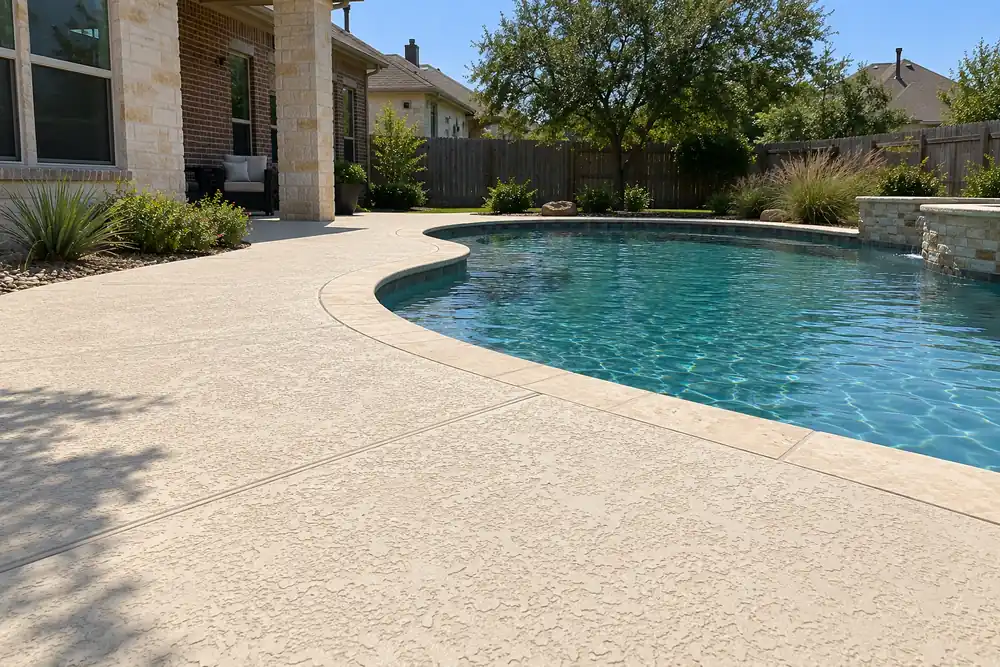
Polished Concrete Floors in Garland, TX
Garland Elite Concrete grinds and polishes concrete floors in Garland, Texas, from a flat ground finish to high-gloss polished concrete, for homes, garages, shops, stores and warehouses. The Concrete Polishing Council grades the result in four levels, from a matte ground floor to a near-mirror shine.
Call or send the form for a free estimate. We'll talk through the sheen and aggregate look you want and what your floor's condition means for them.
Call or request a free estimate any time, 24/7
No charge · answered 24/7
Get free estimates
Polish levels, sheen and aggregate exposure
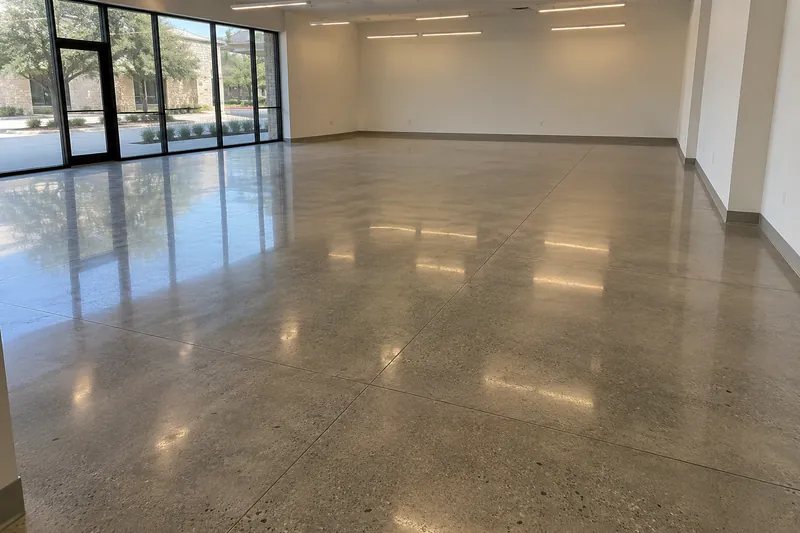
The American Society of Concrete Contractors' Concrete Polishing Council grades appearance by image clarity (DOI): how sharply the floor reflects objects, on a scale of 0 to 100.
Four appearance levels
Level 1, Exposed/Flat (Ground), reads 0 to 9; Level 2, Exposed/Satin (Honed), 10 to 39; Level 3, Polished, 40 to 69; and Level 4, Highly Polished, over 70, a near-mirror reflection that may require grouting. Each level ties to the last diamond used: stopping below the 100-grit resin bond for Level 1, at 400-grit for Level 2, 800-grit or higher for Level 3, and a 3,000-grit resin bond or a high-speed burnisher for Level 4.
Cream, salt and pepper, or full aggregate
The council also sorts floors by how much of the stone shows: Class A, a cream finish of 85–95% cement fines; Class B, salt and pepper, 85–95% fine aggregate; and Class C, full aggregate exposure, 80–90% full aggregate.
Adding color
For color, water-based stains, typically acrylic polymers and pigments, come in dozens of standard colors, including black, white and metallic tints. The options are on our stained concrete page.
Call or request a free estimate any time, 24/7.
(945) 441-5958How concrete floors are ground and polished
General practice, following the Concrete Polishing Council; your estimate covers your floor.
Test on the slab
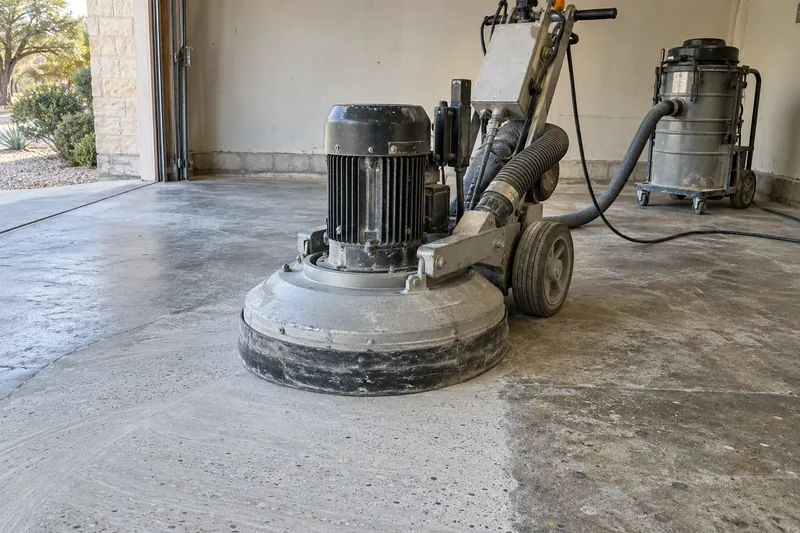
The Concrete Polishing Council says mock-ups should be done on the actual slab to be polished, not off site, because aggregate type and size change the final color.
Grind
The basic sequence grinds with a 30- or 40-grit metal-bonded diamond, then 80-grit, then 150-grit. Dry polishing is the method most commonly used in the industry today.
Densify
A chemical hardener, or densifier, goes on to harden the surface. Some contractors densify after the 80-grit step on soft to medium concrete and around 200- to 400-grit on harder concrete.
Polish
Resin-bond diamonds follow at 100/200, 400 and 800 grit, finishing at 1500 or 3000 grit depending on the sheen wanted.
Check the finish
For compliance testing, the council calls for at least three readings on areas up to 1,000 square feet, plus one more for each additional 1,000 square feet.
Call or request a free estimate any time, 24/7.
(945) 441-5958Polished floors for shops, stores and warehouses
The City of Garland counts more than 30 million square feet of industrial space (August 2026), with its core industrial district in the southwest of the city.
Flatness and levelness
Warehouse floors are specified by two numbers. In the American Concrete Institute's terms, FF shows how bumpy or wavy the surface is and FL how level it is; typical values from ACI 302.1R run from 20/15 for noncritical areas to 35/25 for warehouse floors with moderate or heavy traffic and 45/35 for warehouses with air-pallet use. Floors that miss the numbers may be fixed by grinding, planing, surface repair, retopping, or removal and replacement. New warehouse slabs are covered on our industrial concrete page.
Troweled slabs and delamination
The National Ready Mixed Concrete Association (NRMCA) recommends a maximum air content of 3% for hard-troweled floor slabs, because air-entrained concrete raises the risk of the top layer delaminating. Delamination usually breaks off surface layers ⅛ to ¼ inch thick; NRMCA says extensive delamination may need grinding and a new overlay.
Call or request a free estimate any time, 24/7.
(945) 441-5958Polishing cost per square foot
In 2026 national figures, basic finishes run $3 to $12 per square foot and more decorative options $5 to $15 or more. Other averages put polished floors at $3 to $8 per square foot, and a high-traffic commercial business or retail floor at $5 to $12.
These are national averages, not prices from Garland Elite Concrete. Your estimate is free and based on your floor.
- Cream finish
- $3–$8
- Salt and pepper
- $4–$10
- Rock cut / aggregate
- $6–$12
- Soft matte
- $3–$6
- Low sheen
- $4–$8
- Medium gloss
- $5–$10
- High gloss
- $6–$15
2026 national averages. Not a quote.
Call or request a free estimate any time, 24/7.
(945) 441-5958Questions about polished floors
How much should polished concrete cost?
A 500-square-foot polished floor typically runs $4,000 to $7,500 and a 1,000-square-foot floor $7,000 to $12,000, with labor at $40 to $100 per hour. The price also depends on how many levels of grinding a floor needs. These are national figures.
What are the downsides of polished concrete?
Small floors cost more per foot, and the look depends on the slab. Projects under 1,000 square feet often carry premium pricing of $8 to $15+ per square foot, while spaces over 5,000 square feet may drop to $3 to $6. The Concrete Polishing Council says aggregate type and size change the final color, and that a Level 4 high polish may require grouting.
Does polished concrete need to be sealed?
True polished concrete doesn't require sealing because the densification process hardens the surface, though a stain-guard sealer helps in kitchens, garages and high-traffic areas. An interior concrete floor can last indefinitely when properly installed and sealed. For coatings and other garage options, see our concrete garage floors page.
How long does it take to polish a concrete floor?
Most residential polishing projects take 2 to 4 days for spaces up to 2,000 square feet, while commercial spaces of 5,000 to 10,000 square feet typically take 1 to 2 weeks.
What does a concrete densifier do?
Prosoco, a densifier maker, says a silicate densifier chemically converts the calcium hydroxide in concrete into calcium silicate hydrate (CSH), the compound that binds concrete. The main types are sodium, potassium and lithium silicates, plus newer colloidal silicates, and contractors credit densifiers with less dusting, higher gloss, more abrasion resistance and a longer floor life.
Free estimates for polished concrete floors
Garland Elite Concrete answers calls and estimate requests 24/7 for polished concrete in homes, garages, shops and warehouses in Garland and nearby towns. Tell us the floor size and the finish you have in mind.