Industrial Concrete in Garland, TX
Garland Elite Concrete pours industrial concrete in Garland, Texas, from warehouse and plant floors built to a flatness spec to the slabs that tilt-wall panels are cast on. According to the City, Garland's core industrial district is in the southwest of the city, where it approved two Class A flex buildings of 171,000 and 183,000 square feet on Marquis Drive and Kings Road in 2019. The City's economic development office lists the Jupiter Miller Business Center, a former Raytheon building redeveloped into 750,000 square feet of new industrial space.
Send the floor specification or the drawings for a free estimate. We'll talk through the flatness and levelness numbers, the joint layout and the loads your lift trucks and racking will put on the slab.
Call or request a free estimate any time, 24/7
No charge · answered 24/7
Get free estimates
Warehouse floor flatness: FF and FL numbers
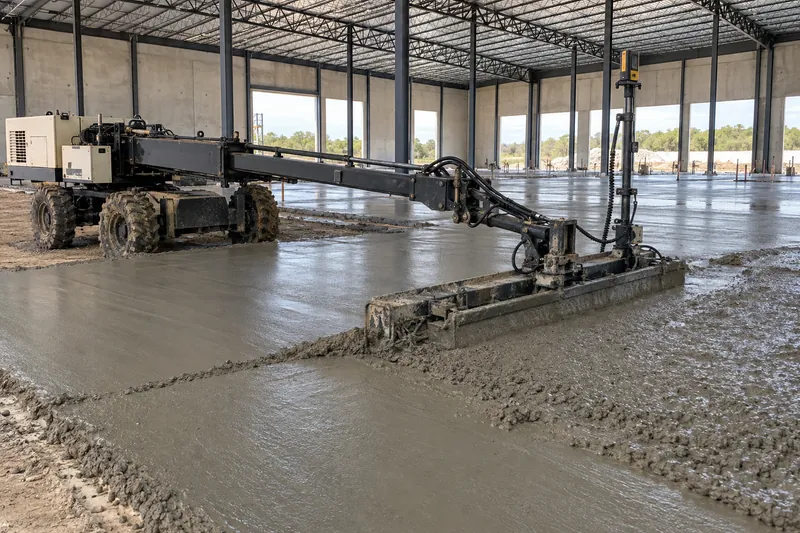
Industrial floors are specified by two numbers. In the American Concrete Institute's floor flatness terms, FF shows how bumpy or wavy the surface is, which reflects the strike-off and finishing, and FL shows how level the slab is, which reflects how level the forms were set. FF is measured from the floor's curvature over 2-foot intervals and FL over 10-foot intervals; for comparison, a driveway might score an FF of 10.
Typical FF/FL values by use
The report's table, drawn from ACI 302.1R, lists typical values of 20/15 for noncritical areas such as mechanical rooms and parking structure slabs, 25/20 for carpeted offices, 35/25 for thin-set flooring or warehouse floors with moderate or heavy traffic, and 45/35 for warehouses with air-pallet use, ice or roller rinks.
Racking height and levelness
The report also notes that a warehouse floor's levelness can limit how high pallets can be safely stacked. Typical warehouse specs, drawn from engineering practice, run 25/17 for normal lift traffic with no racks, 35/25 for racking of about 20 feet, and 50/35 for taller or automated racking of 35 feet or more.
Call or request a free estimate any time, 24/7.
(945) 441-5958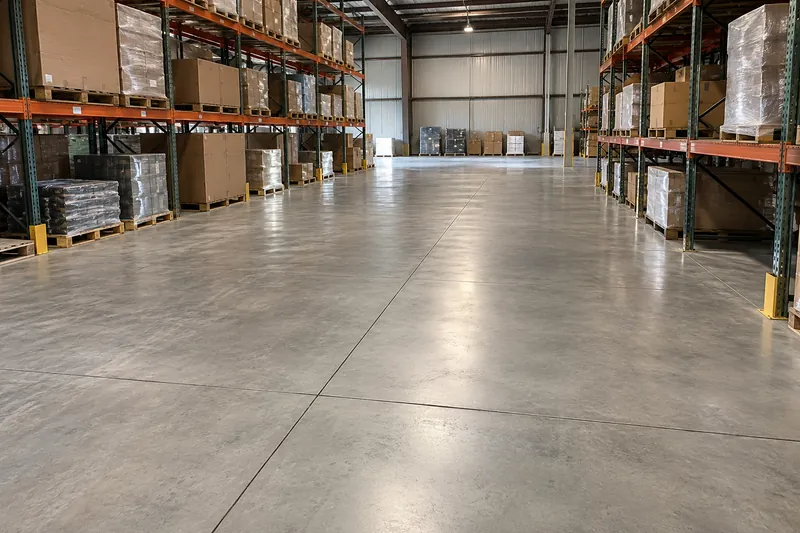
Joints, finishes and mix for industrial slabs
Joints under heavy traffic
The NRMCA says joints in floors that carry heavy traffic should be filled with a material able to support the joint edges, that keyed joints are not recommended for industrial floors, and that metal dowels should be used in slabs carrying heavy loads. Its general rule for slabs on grade spaces joints 24 to 36 times the slab thickness, and no more than 15 feet apart.
Hard-troweled finishes and delamination
Delamination breaks off surface layers, typically 1/8 to ¼ inch thick, and the NRMCA says extensive delamination may need grinding and a new overlaid surface. To limit the risk on floors that get a hard-troweled finish, it advises against air-entrained concrete and recommends a maximum air content of 3%.
Densified and polished surfaces
A silicate densifier hardens the surface: Prosoco, a densifier maker, says the silicate reacts with calcium hydroxide in the concrete and turns it into calcium silicate hydrate, the compound that binds concrete. Ground and polished floors are covered on our polished concrete page.
- Joint filled with a material that supports its edges (NRMCA)
- Hard-troweled finish, 3% air content at most (NRMCA)
- Flatness and levelness to the FF/FL spec (ACI 302.1R)
- Metal dowels at joints under heavy loads (NRMCA)
- Vapor retarder at least 10 mils thick under interior slabs (NRMCA)
- Houston Black clay, high shrink-swell (USDA)
Call or request a free estimate any time, 24/7.
(945) 441-5958Plants, warehouses and clay soil
In 2019 the City named plastics, food and chemicals as Garland's target industry clusters. Its 2025 list of principal employers, which leaves out retail and government, is led by Kraft Foods (796 employees), US Food Service (520), Atlas Copco (460), SilverLine Windows (425) and Hatco (390), and the City says Daisy Brand, in Garland since 1993, is investing more than $25 million in a new innovation and research center.
Floors for tilt-wall buildings
In tilt-wall construction, the Tilt-Up Concrete Association says the wall panels are cast horizontally on the building's own slab-on-ground, so the floor is poured before the walls go up. Industrial floors sit alongside parking lots and site paving in our commercial concrete work.
Clay under the slab
Houston Black clay is the most common soil mapped in Garland. The Soil Science Society of America's Texas soil booklet says construction on it is often plagued by cracking from shrinking and swelling, that hydrated lime is often added to stabilize the clay, and that building foundations need steel reinforcement. We'll talk through the subgrade preparation for your site.
Outside the city, Garland Elite Concrete also pours industrial concrete in Farmers Branch.
Call or request a free estimate any time, 24/7.
(945) 441-5958Industrial floor and warehouse cost
Ready-mix is the biggest material cost, typically $120 to $160 per cubic yard delivered in 2026 figures. For a finished surface, polished concrete on a high-traffic commercial or retail floor runs $5 to $12 per square foot (2026), and a whole warehouse costs $25 to $65 per square foot (2025), not counting the land.
These are national averages, not prices from Garland Elite Concrete. A floor price needs the specification and the drawings, and the estimate is free.
Call or request a free estimate any time, 24/7.
(945) 441-5958Industrial floor questions
What are the downsides of concrete flooring?
Cracking and curling come with the material. The American Concrete Institute's slab-on-ground guide says crack-free and curl-free floors are unrealistic to expect, however well a slab is designed and built, and that owners should be told to expect some of both on every project. Curing can curl a slab in its first days, joints in heavy-traffic floors need a filler that supports their edges to keep them from spalling, and a troweled surface can delaminate, breaking off layers 1/8 to ¼ inch thick.
What is a superflat floor?
It's a floor built to very high flatness numbers. A superflat floor's FF could be as high as 125, against about 10 for a driveway. ACI 302.1R lists over 50/50 for movie and TV studios, and taller or automated warehouse racking typically calls for 50/35.
When is a floor tested for flatness, and what if it misses?
The American Concrete Institute's floor flatness guidance says the test should be run within 72 hours of finishing, because curing can curl the slab, and that local minimum values are typically 60% of the overall numbers. Floors that miss the spec may be fixed by grinding, planing, surface repair, retopping, or removal and replacement.
Do warehouse floors need a vapor barrier?
The NRMCA recommends a vapor retarder at least 10 mils thick under interior slabs, and calls it sensible planning to include one under every interior floor slab in every building. It says vapor retarders are generally not necessary under exterior slabs on grade.
How long should a new warehouse floor cure?
The NRMCA says curing should begin right after finishing and typically continue 3 to 7 days, and that concrete left to dry out can lose as much as 50 percent of its potential strength. Heat matters as well: concrete cured at high temperatures early on is weaker at later ages than the same concrete cured around 70°F, and DFW Airport's normal highs run 95.6°F in July and 95.8°F in August (1991-2020 normals).
Free industrial concrete estimates
Garland Elite Concrete answers calls and estimate requests 24/7 for warehouse and plant floors and the site concrete around them, in Garland and nearby cities. Send the floor specification or the drawings.